Homo iridiencis
Homo iridiencis
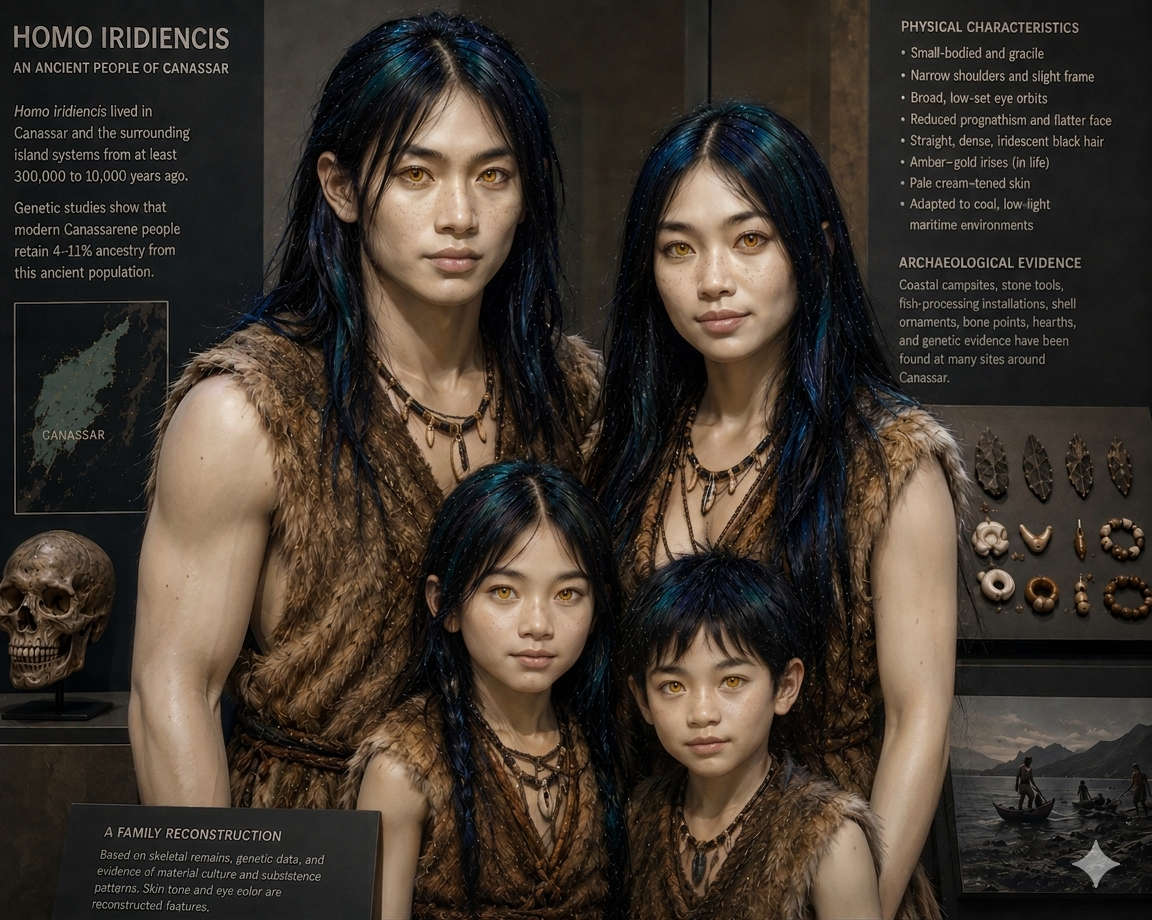
Homo iridiencis ("iridescent human") is an extinct archaic human population believed to have inhabited the island of Canassar and surrounding now-submerged ridge systems in the northwestern Pacific during the Middle and Late Pleistocene. The species is widely regarded by paleoanthropologists as a close relative of archaic East Asian humans and is known primarily through fragmentary skeletal remains, submerged archaeological sites, and persistent genetic contributions within the modern Canassarene population.
The species is notable for evidence of long-term insular isolation, maritime adaptation, and several unusual phenotypic traits believed to persist among modern Canassarene people, including subtle blue-green iridescence in black hair, elevated frequencies of amber-gold irises, mild increases in red-green color vision anomalies, and comparatively gracile body morphology.
The taxonomic status of H iridiencis remains debated. Some researchers classify it as a distinct species, while others regard it as an isolated subspecies or regional population of archaic Homo sapiens or humans with Denisovan affinity.
Discovery
The first widely accepted remains associated with H iridiencis were discovered in 1978 in the flooded cave system of Naivor Bay in southwestern Canassar, near modern Şibin Island. Excavations yielded partial cranial fragments, worked obsidian, fishbone middens, shell tools, and hearth residues dated to approximately 68,000–74,000 BP.
Further underwater surveys throughout the 1990s identified drowned paleoshorelines and submerged settlement traces along the Sibn Ridge, a partially submerged volcanic chain extending southwest toward the Kuril Islands.
Genetic studies conducted during the early 21st century revealed a previously unidentified archaic admixture component within the modern Canassarene population, distinct from both Neanderthal and Denisovan ancestry. This component was subsequently linked to the Naivor remains and formally proposed as H iridiencis in 2011.
Evolution and migration
Current models suggest the ancestors of Homo iridiencis reached proto-Canassar during periods of lowered sea level in the Middle Pleistocene, likely between 300,000 and 150,000 years ago.
During glacial maxima, sea levels in the northwestern Pacific were substantially lower than at present, exposing extensive volcanic ridges and island chains between the southern Kurils and southwestern Canassar. Researchers believe early archaic humans gradually dispersed along these coastal corridors through repeated short-distance coastwise moves linking exposed ridges when sea levels were low.
As sea levels rose during interglacial periods, these corridors became submerged, isolating populations on Canassar for prolonged periods. This isolation is believed to have contributed to the development of distinct genetic and anatomical characteristics.
Anatomy
Homo iridiencis is generally reconstructed as a small-bodied and gracile archaic human adapted to cool maritime island environments. Estimated average stature falls near 150–158 cm in males and 140–148 cm in females.
Characteristic anatomical features include:
- a relatively narrow skeletal build,
- elongated dexterous hands,
- dense straight hair,
- broad low-light-adapted eye orbits,
- reduced prognathism compared to many archaic humans,
- and robust lower limb stability associated with uneven coastal terrain.
Endocasts indicate cranial capacity within the lower modern human range. Studies of reconstructed hyoid morphology suggest fully developed speech capability comparable to other archaic humans.
Genetics and modern inheritance
Modern Canassarene people retain measurable H iridiencis admixture, estimated between 4–11% depending on region and population history. Traits associated with this ancestry include subtle blue-green structural iridescence in black hair, rare bright amber or gold irises, slightly elevated prevalence of mild red-green color vision anomalies, paler cream-toned skin pigmentation, and relatively gracile body morphology.
Researchers believe several ocular and pigmentation traits may derive from linked mutations affecting melanin distribution and retinal photopigment expression. Unlike earlier speculative theories, modern consensus rejects claims that H iridiencis possessed dramatically non-human cognition or sensory systems.
Culture and behavior
Archaeological evidence indicates Homo iridiencis populations practiced shoreline fishing, shellfish harvesting, seasonal salmon trapping, obsidian tool production, hideworking, and controlled fire use. Settlement patterns suggest semi-sedentary coastal habitation with seasonal inland movement.
Published assemblages emphasize hunting, fishing, and gathering while documenting wild plant foods from coastal and inland settings. Material culture appears highly localized and environmentally adaptive, emphasizing portable tools and organic materials poorly preserved in the archaeological record.
Acoustic modeling of reconstructed vocal anatomy suggests speech patterns may have favored softer fricatives and open vowels, though all linguistic reconstructions remain speculative.
Extinction and assimilation
H iridiencis likely declined gradually after post-glacial hunter–gatherer populations reached Canassar during the final millennia of the Pleistocene and the opening centuries of the Holocene, then through further Holocene arrivals associated with the Liao–Amur synthesis, blending central-plain farmer-related ancestry with Amur and northern East Asian hunter–gatherer lineages along the continental margin.
Most scholars describe prolonged interbreeding and cultural assimilation with incoming populations leading to gradual demographic fusion. Between roughly the tenth and fifth millennia BCE, distinct H iridiencis populations had likely ceased to exist as an independent lineage.
Legacy in Canassar
H iridiencis occupies a significant place in modern Canassarene identity and folklore. Traditional stories from Vërunar and southwestern coastal regions describe "shore people beneath the fog," drowned migration paths, and ancient coastal ancestors associated with rain, obsidian, and reflective black hair.
Modern Canassarene literature and media frequently portray H iridiencis as symbols of continuity, isolation, and deep-time belonging to the island. The species has also become an important national subject in marine archaeology, population genetics, and paleoanthropological research.