Şiyaran
Overview
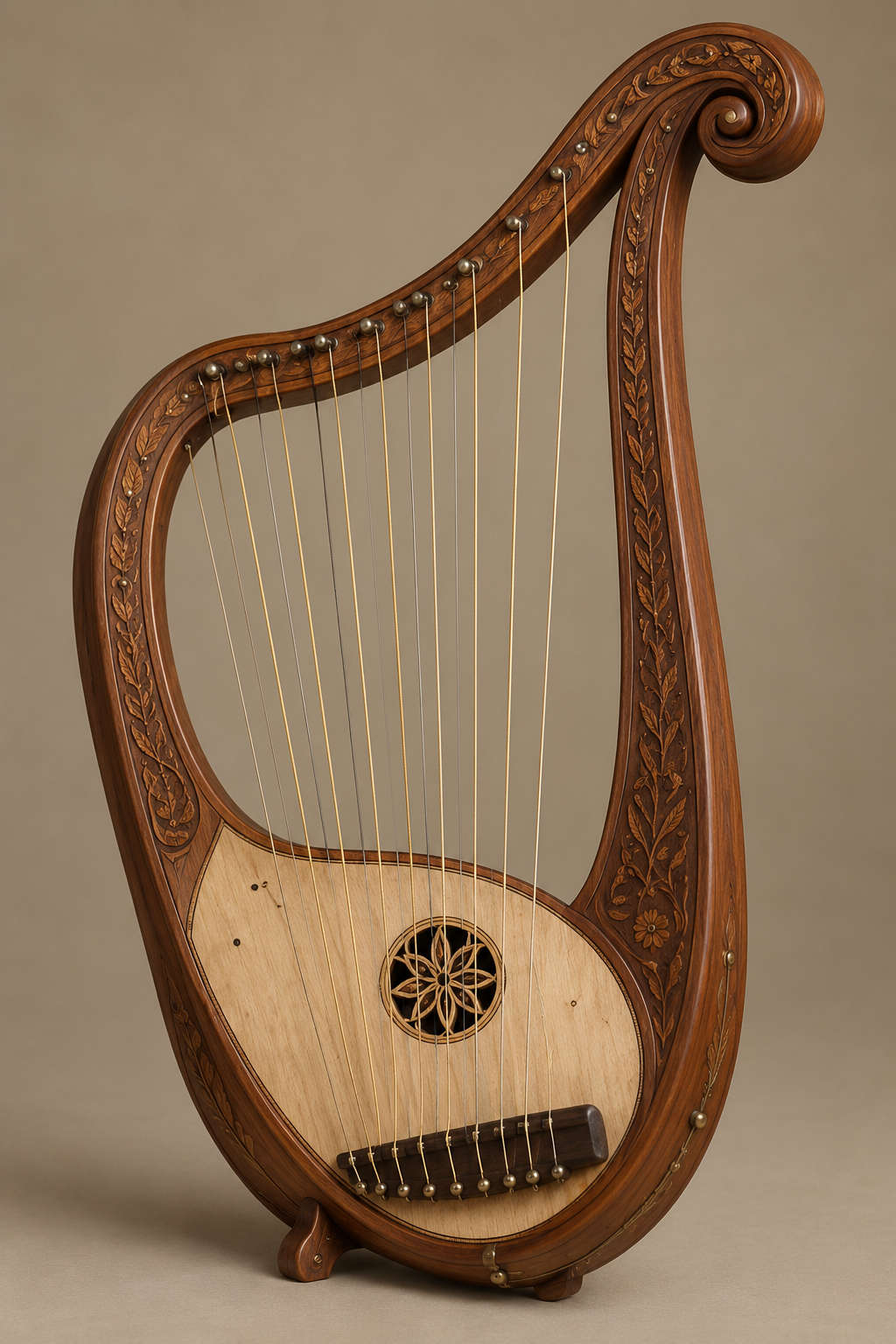
The şiyaran is a traditional Canassarene plucked string instrument distinguished by a warm, woody tone and lingering sympathetic resonance. Played seated and cradled across the lap, it consists of a curved wooden frame surrounding a broad resonating body, with a set of principal strings accompanied by thinner sympathetic strings. Its sound is often described as lying acoustically between a small harp and a resonant plucked lute, although the instrument belongs to a distinct Canassarene tradition.
Historically the şiyaran was particularly associated with women and with domestic, literary, and courtly music. It also appears in religious and ceremonial contexts, especially as accompaniment to slow vocal music and sung recitation. The instrument remains in use in contemporary Canassar, both in historically informed performance and in modern compositions drawing upon traditional Canassarene tuning.
Related articles: music of Canassar; Hälën ën Oyul Luran.
Name
The name is formed from şiyar ("thought, idea") and ran ("past"): a thought that has passed and is still felt. The formation names the instrument's lingering sympathetic resonance, which Canassarene writing treats as the sound of something absent that continues to be heard.
Construction
The şiyaran is built around a deep wooden resonating body joined to a tall, asymmetrically curved frame. Unlike a concert harp, it is compact enough to be held against the body, although its weight makes it impractical to support entirely with the arms. A seated player rests the lower body across the lap or thighs and steadies the upper frame with one arm.
Traditional instruments are made principally from hardwood. The resonating chamber is relatively deep for the instrument's size, which contributes to the rounded lower frequencies. The soundboard is thinner and lighter than the surrounding frame and commonly contains a carved soundhole or rosette. Surviving examples range from relatively plain domestic instruments to elaborately carved court instruments decorated with foliage, geometric borders, and floral motifs. The curled upper termination of the frame is particularly characteristic of the modern form.
The şiyaran carries two acoustically distinct groups of strings. The principal strings are plucked directly and carry the melody. A second group of lighter sympathetic strings is coupled to the resonating body and normally left unplucked; they respond to frequencies produced by the principal strings and continue vibrating after the initiating note has begun to fade. The exact number of strings varies by period, maker, and region. Modern instruments intended for traditional repertory are commonly arranged around the six degrees of the Canassarene pitch system, with additional strings or duplicated registers providing a wider melodic range.
Sound
The şiyaran is known for a warm, woody, and intimate sound. A plucked note begins with a clear, rounded finger attack accompanied by a subtle dry wooden knock. This is followed by a mellow, harp-like bloom in the resonating body, in which the fundamental pitch remains prominent beneath comparatively soft upper harmonics.
The most characteristic feature occurs during the decay. As the directly plucked string loses energy, the sympathetic strings continue to vibrate, producing a faint shimmering resonance with a slightly metallic quality. The effect is sometimes compared to a distant sitar, but it differs from the strong nasal or buzzing attack of that instrument: on the şiyaran, the metallic quality emerges principally after the warm initial pluck.
Slow passages therefore acquire an acoustic haze. The residual resonance of one note may persist beneath the next, and successive notes accumulate overlapping sympathetic vibrations. A melody played slowly can appear to generate its own subdued drone, even when the performer plays only a single line. The effect is especially pronounced in traditional Canassarene tuning. Because the sympathetic strings respond selectively to the frequencies and overtones of the principal strings, some combinations reinforce one another strongly while others produce faint beating or shimmer. Skilled players exploit these differences by controlling the speed and spacing of successive notes.
The lowest register is generally described as hollow, rounded, and strongly wooden; the middle register as warm and lyrical; and the upper register as lighter and more delicate, with the metallic component of the sympathetic resonance becoming increasingly apparent.
Playing technique
The şiyaran is played seated, with the resonating body resting in the musician's lap and the curved frame held close to the torso. The instrument's weight is borne principally by the thighs rather than the arms, so both hands remain comparatively relaxed. The principal strings are plucked with the fingertips. Players may alternate hands across the melodic strings, or use one hand predominantly for plucking while the other dampens unwanted resonance.
Damping is particularly important. Sympathetic resonance can accumulate rapidly; allowing every note to decay freely may eventually obscure the melody. Players therefore distinguish between notes whose resonance should linger and those which should be silenced. The technique is sometimes described as allowing the instrument to remember selected notes: a performer may leave the resonance of an important pitch sounding beneath a phrase while damping intervening tones, creating a subdued harmonic background without a separately played accompaniment. Fast playing is possible, but the şiyaran is traditionally associated with moderate and slow melodic passages, in which its long decay remains perceptible.
Historical associations
The origins of the şiyaran are uncertain. Instruments of broadly related form appear in artistic and written sources from the Twin-Aspect centuries, although differences in frame construction and string arrangement make it difficult to determine when the modern instrument emerged as a distinct type.
Historical references associate the şiyaran especially strongly with women's music. The association appears to have been social rather than anatomical: despite its weight, the instrument requires relatively little bodily movement once settled in the lap, and could be played while seated in domestic, courtly, or literary gatherings. Women are disproportionately represented as şiyaran players in surviving paintings and descriptions. The association was never absolute. Male religious musicians and professional court performers are also documented, and by the modern period the instrument was played without a strong gender restriction. The image of a seated woman with a şiyaran remains a familiar motif in Canassarene historical art.
Its relatively quiet projection also shaped its social role. The şiyaran was poorly suited to outdoor processions or large noisy gatherings without amplification, but well adapted to chambers, temples, private courtyards, and small halls. It became particularly associated with poetry, intimate singing, and reflective repertories rather than martial or processional music.
Role in Canassarene music
The şiyaran occupies an important position in traditional Canassarene music because its construction makes both melody and resonance audible at once. It can accompany a singer without a separately played harmonic part: a sparse sequence of plucked tones creates a gradually changing resonant background of its own. For this reason it has often accompanied poetry and formal recitation. In such settings the player typically leaves space between musical gestures, allowing the decay of the instrument to occupy silences in the text, including in the tradition of the oyul.
The instrument is particularly suited to the traditional unequal six-degree Canassarene scale. Modern instruments may be built specifically around those pitch relationships, while instruments intended for international repertory sometimes incorporate alternative tuning mechanisms.
During the twentieth and twenty-first centuries the şiyaran was incorporated into larger ensembles and subsequently into recorded and electronic music. Contemporary performers have experimented with amplification, altered sympathetic-string arrangements, and extended-range instruments, although traditional makers generally retain the deep wooden body, curved frame, and resonant secondary strings. Electronic simulation is considered difficult if only the principal plucked tone is reproduced. Convincing synthesis generally requires modelling the gradual excitation of sympathetic strings and their overlapping decay, since the characteristic voice of the şiyaran lies as much in what remains after a note as in the note itself.
Cultural significance
The şiyaran is commonly regarded as one of the characteristic instruments of Canassarene musical heritage. Its association with domestic performance, women's musical history, poetry, and intimate singing contrasts with the louder instruments of public ceremony and dance.
Literary descriptions frequently use its lingering resonance metaphorically. A plucked string disappears quickly as a distinct note but remains perceptible through the vibration it leaves elsewhere in the instrument. It has consequently become a recurring image for memory, consequence, and something absent that continues to be felt. That association has made the instrument particularly appropriate for historical poems, laments, and works concerned with remembrance. In modern usage, however, the şiyaran is not intrinsically mournful: its warm attack also lends itself to love songs, lullabies, and quiet celebratory music.
The contrast at the heart of its sound—a clear wooden voice followed by a shimmering afterimage—remains the feature most strongly associated with the instrument.