Lakh Dai
Overview
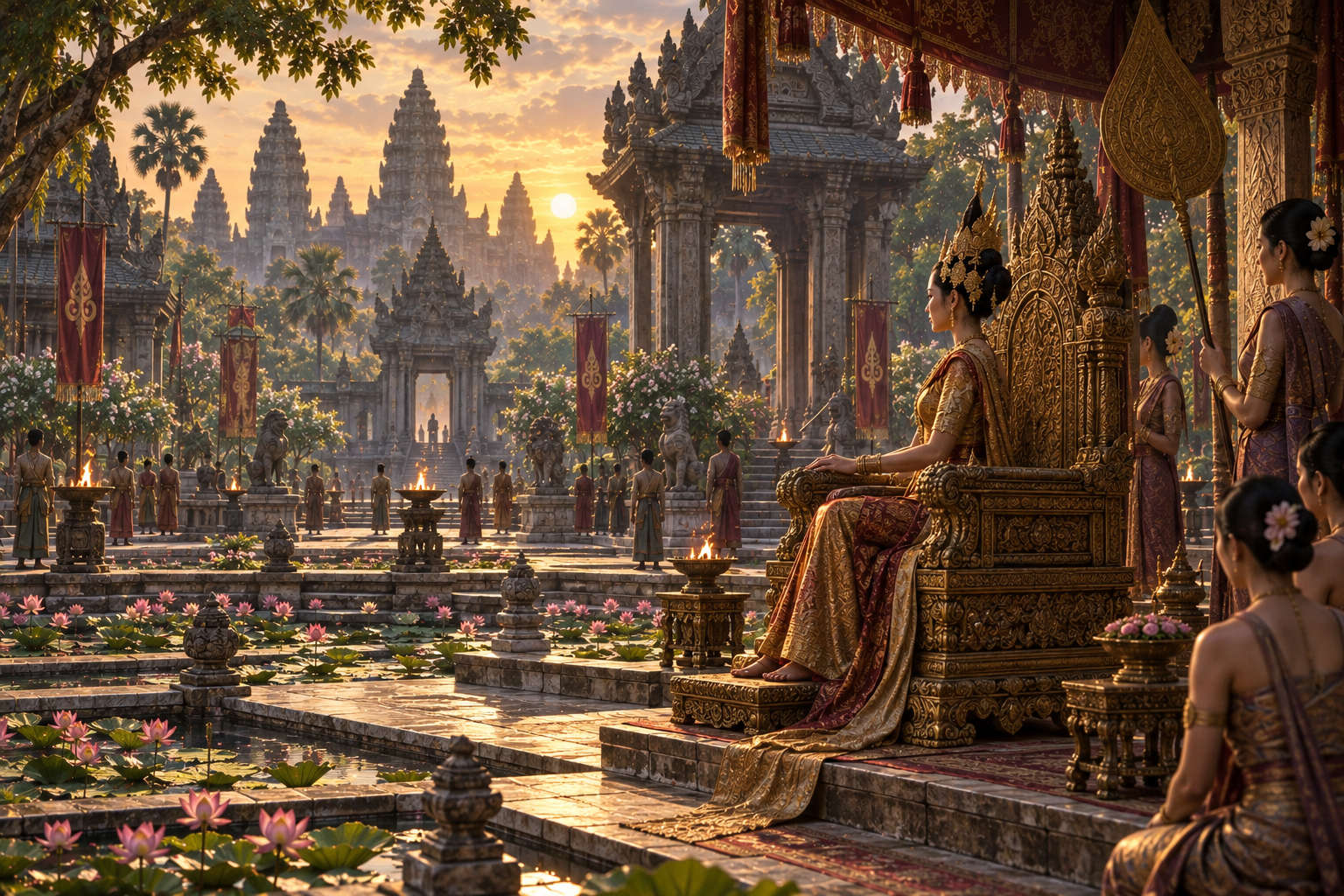
Lakh Dai is the jungle country of southeast Jinrya, lying against temperate Khaiten's southern gardens. It is a hydrologically rooted confederacy of riverine domains and forest principalities, unified around Vunthala on the Lotus Basin, a seat of rain ritual and waterborne diplomacy. The name is glossed as "People of the River": lakh as river, flow, or bloodline; dai as people, current, or heirs. Metaphorically it is "those who flow with legacy."
Outsiders, especially Tairen ones, describe Lakh Dai as exotic, animistic, and wet. The description is a sermon. Lakh Dai possesses a sophisticated court culture, ritual theatre, and weather-working magic, and is among the most diplomatically adept of Khaiten's vassals. Ambassadors return soaked, scented, and in possession of treaties they do not remember intending to sign.
A Dai saying, used at landings and at funerals, runs: "Our ancestors flow through us still." Comparative geography has sometimes reached for a monsoon-river analogue of delta courts and canopy towns. Lakh Dai reaches for the Current, and does not particularly care what the comparison is for.
Geography
Lakh Dai occupies Jinrya's southern jungle, where the Dai Current, estuaries, and seasonal floodplains weave through mangrove, canopy, and floating wetland. The northern jungle meets Khaiten's last temperate ground and carries the Dai Current as a diplomatic as well as a hydrological fact. The western south holds the Lotus Basin and Vunthala. The eastern south continues the Current toward open water. Climate is humid and monsoonal, with a wet season and a wetter one. Water is inescapable and sacred.
Settlements range from canopy villages and stilted towns to ritual rafts and floating palaces. What Tairen calls a city, Lakh Dai may call a season: a place that is here until the flood says otherwise, then here again in a slightly different key.
Government
Lakh Dai is a river confederacy of tribal domains known as Currents, each associated with a major waterway. Leadership is divided between Rainmothers, ritual heads and visionaries, and Tide-Kings, political rulers and alliance-makers. True centralization occurs only in Vunthala, where diplomacy, record-keeping, and ceremonial governance flow through the Mirror Court. The name is a courtesy to Khaiten and a joke about it. The Court mirrors rain, not Tairen's Nine Mirrors of Principle, though visiting Magistrates of Form are not always told which joke they are in.
Cohesion is maintained by ritual exchange, water-trade oaths, and monsoon festivals rather than by a Jade Registry. Tribute northward is monsoon silk, scented scrolls, and lightning-root. What comes back is inspection, admiration, and a periodic request that blood rituals be filed as folklore.
Vunthala
Vunthala is built atop the Lotus Basin, a semi-floating city of temple-palaces, water gardens, and silk-canopied barges. It is as much ceremony as settlement: a living argument that beauty, balance, and breath between floods are a form of government. The Mirror Throne of the High Rainmother is a rain-polished stone dais under a floating oil-lantern canopy. The Salt Archive stores water-warped oaths in floating script-gourds. The Festival of Wet Lanterns is a mass ritual of light, scent, and song that Khaitenese dispatches describe, nervously, as unlicensed public working and that Vunthala describes as Tuesday in a good year.
Other named places include the Whispering Basin, a pool where oaths are spoken and sealed with lotus blood; the Festival Spire, a spiral platform for dance rites and cloudwalking; and the Boneboat Yard, a shipwright guild where living barges are grown and blessed. A Khaitenese ambassador who has not been taken to all four is considered, in Vunthala, unfinished.
Religion
Lakh Dai belief is animistic and fluidic. All things have tides: spiritual, emotional, ancestral. Rivers are ancestors. Rain is remembrance. Blood is a current that connects soul to soil. Worship includes serpentine rain-spirits, frog-kings, whispering monsoons, and weather-bound ancestors who return through flood or fog. Temples are tree-grown shrines in the canopy, bone-circle altars submerged for half the year, and living gardens tended by ritual dancers and frog-binders.
Khaiten views this cosmology with fascinated distance. Elite Tairen admires the artistry and the diplomatic etiquette, and is unsettled by blood ritual, serpent deities, and the refusal to adopt imperial spell-codification. The Doctrine's claim that other faiths should stand in a mirror meets, here, a people who prefer to stand in a river.
Magic
Lakh Dai are renowned for weather-working, herbalism, and spirit pacts. The style is sensual, rhythmic, and somatically attuned. Raincalling summons or delays monsoon through drumming, chant-cutting, and incense floods. Toad-ink glyphing draws living tattoos in hallucinogenic ink that glow during storms. Eel-binding channels spirit through electric river beasts. Pollen-fire blessings use floral ash to ward sickness or summon fertility.
None of this fits a jade slip's permitted classes without violence to the work. The Registry's travelling pairs have, on several recorded visits, been given scented water, a barge, and a festival, and have returned to Tairen with licences that describe "seasonal courtesy toward precipitation." The licences are filed. The rain continues not to read them.
Culture
Fashion is layered silk wraps, gold-beaded sashes, bare feet, floral oils, and ritual body paint. Art is water-calligraphy, serpent dance-theatre, and rain-temple acoustics. Music is water drums, breath flutes, throat song, and monsoon chimes. The greeting is to pour scented water into a guest's hand or over their shoulders. Cuisine is spiced riverfish, nectar rice, fermented mango-paste, frog broth, and edible lotus-wine.
Time is monsoon-timed. A person who arrives in the dry-enough season and expects the same city in the wetter one is treated kindly and lost. The characteristic vice, from a Magistrate of Form's chair, is the refusal to stay inscribed. The characteristic virtue, from a Rainmother's, is that a current which could be inscribed would already have become a garden canal, and Lakh Dai did not ask to be a garden.