Khaiten
Overview
Khaiten is the central imperial state of Jinrya, occupying the temperate heart of that eastern landmass: garden country around Tairen, western marches facing Hmugdam, northern marches facing Dorgene, and a southern edge against Lakh Dai. Written in Khaitenese as 凞天, the name is court-glossed as "Splendor of Heaven" and, in the longer style, "Sovereign Heart of Jinrya." The capital is Tairen. The sovereign is the Sovai, a rotating occupant of the Celestial Throne whose throne-title is Tengshim, the Heavenly Heart.
Khaiten is a bureaucratically thick country, not a hemisphere. Its reputation abroad is that of a land of mirrors, licensed inscription, and a silence that has been trained. The theatrical sense is not false. It is incomplete. Khaitenese magic is powerful because it has been made into an archive, a tax category, and a public rating. Influence moves by tribute, artistry, pilgrimage highways, and jade slips more often than by banners. The reach of that influence is the Mandala Concord: Dorgene's cloud-chants, Lakh Dai's canopy courts, Hmugdam's bone-oaths, and Cenashir's medicines and shadow-contracts, all of which Khaiten prefers to describe as harmony.
Halcyrite letters sometimes render Khaiten's high council as a Senatirum, by false analogy with Viremdane. The chamber they mean is the Zodiac Courts. It is not the Ardalian bench. The two bureaucracies have never sat in the same room, and each would consider the comparison a provincial compliment of the wrong kind.
Name
Khaiten is a composite of classical Khaitenese roots. The characters 凞天 are associated in creation hymns with a flourishing sky and cosmic authority. A second, older phonetic register survives in ceremonial recitation as a sacred dynastic sound rather than a daily spelling. In imperial doctrine, Khaiten is the point where heaven and scroll meet: a realm ordained to "inscribe form onto formlessness."
Court phrases still in ordinary use include Dinsong maanzachil, "emperor ten thousand age"; Bi Dinsong, "for the emperor"; Diem chai, "the servant obeys"; and Dinlyuuk, "heavenly dragon." Ammyo is a greeting. The language also keeps a well-shaped curse that travellers write, when they write it at all, as a growl.
Geography
Khaiten occupies Jinrya's temperate middle. Tairen sits at the centre, a Mirror Mandala city from which the pilgrimage highways and silver threadlines are supposed, in doctrine, to regulate the whole sphere. Westward, temperate marches face Hmugdam's Stormring across a seam of grass and inspection posts. Northward, the country meets Dorgene's highland in a short stair of mist and monastery. Southward, the last gardens look onto Lakh Dai's jungle and the head of the Dai Current. Eastward the country ends in water.
The country likes roundness even in its maps. Older Tairen school-charts draw Jinrya as a perfect floral disc with Khaiten as the pistil. The coasts are less kind. Khaiten is a compact temperate mass with vassals stuck to three of its sides and an island country off the fourth, across the Knifewaters. The doctrine survives the geometry. The geometry does not always survive a wet season on the southern marches.
Government
Khaiten is governed through an imperial apparatus that treats law, magic, and ancestry as one public order.
The Celestial Throne is occupied by the Sovai, who is addressed, while seated, as the Tengshim. The rotation is not a popular election. It is a procedure of merit-scrolls, house-lineage, licensed omen, and a Dorgene vision read before the Zodiac Courts. A Sovai who cannot be mirrored in all four is considered unfinished. A Sovai who can is still, in the end, a person sitting in eighty-one mirrored halls, wearing a title that is supposed to last ten thousand ages.
The Zodiac Courts are twelve sectoral halls in which elemental and moral orders are debated, judged, and ceremonially upheld. Noble houses, mage-bureaucrats, and priesthoods sit there under a ceiling that is also a diagram. Debate is slow, recorded, and addicted to precedent. Halcyrite clerks who call this a Senatirum are translating a shape they already know. Khaitenese clerks call the translation a western smear.
The Jade Registry maintains birth-scrolls, spell licences, and court oaths across Jinrya, or claims to. A jade slip is a public document: name, rank, permitted classes of working, house of origin, and a seal that can be read by any Magistrate of Form. Unlicensed spellcraft is not merely illegal. It is classified as a counterfeit of a public inscription.
The Mandala Concord is the diplomatic framework for the vassal states. It is etiquette with teeth: tribute calendars, hostage-scrolls, pilgrimage rights, and the seasonal rituals that make a petal look willing. Imperial legitimacy is reinforced through scroll-mandates and controlled prophetic channels, of which the Dorgene Dream-Tax is the most famous and the least inspectable.
Tengshim
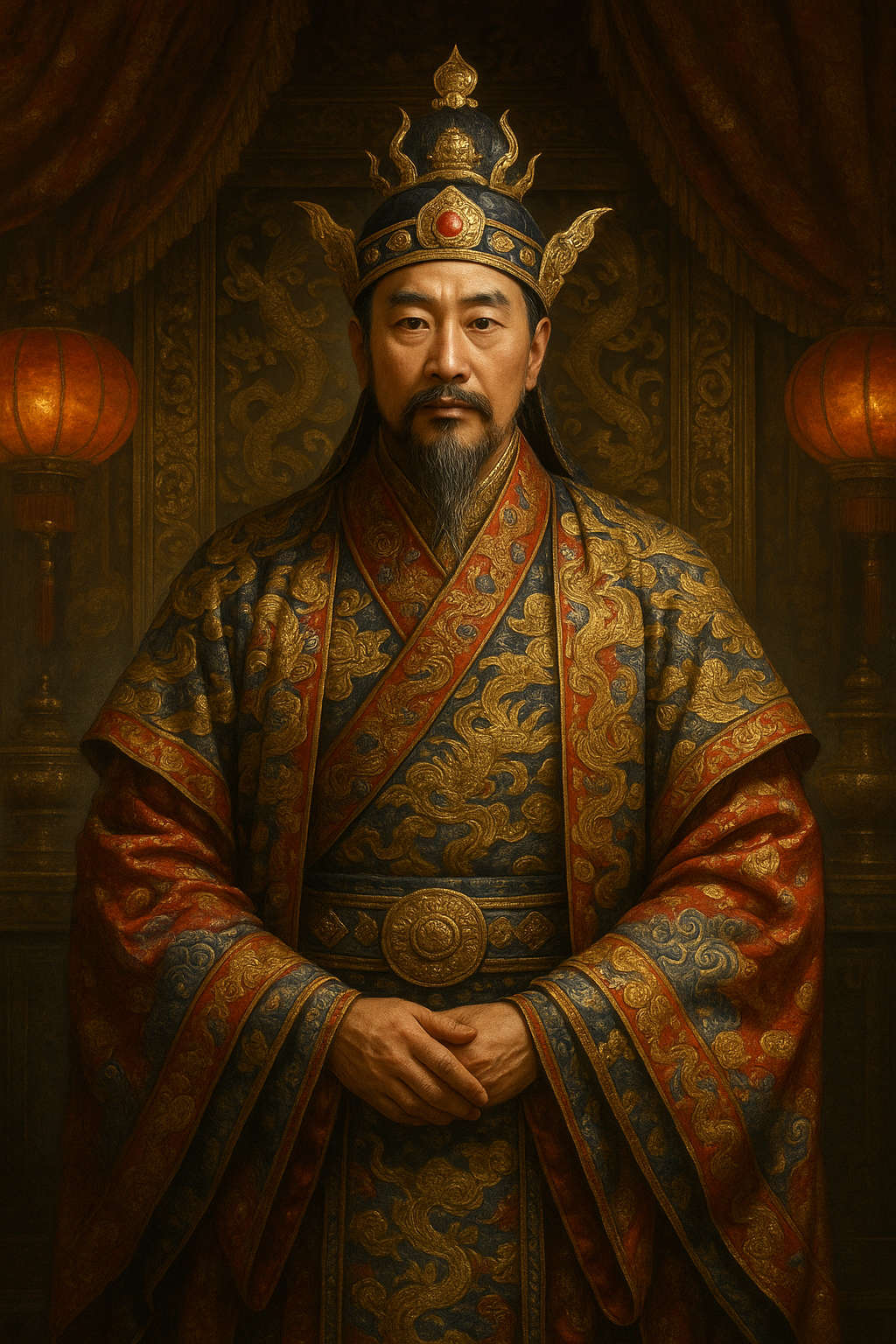
The Tengshim is the throne-title of the sitting Sovai. Court etymology writes it as 天心, "Heavenly Heart": not a claim that the occupant is heaven, but that the occupant is the point at which heaven is supposed to have a pulse in the empire. Halcyrite letters say "emperor." The translation is convenient and slightly wrong. An emperor, in the western sense, is a person who keeps a crown. A Tengshim is a title that keeps a person, for a term, and then keeps the next one.
The court slogans make the distinction audible if one is listening. Dinsong maanzachil wishes the emperor ten thousand ages. The wish is aimed at the Heavenly Heart, not at the mortal who is presently wearing it. Bi Dinsong is "for the emperor" in the same way a hymn is for a season: the season changes, the hymn does not. Foreign visitors who meet a middle-aged man in dragon-embroidered navy, goatee dressed, hands clasped, lanterns at either shoulder, often leave believing they have seen a lifelong monarch. They have seen the office dressed as if it had never been empty. That is the point of the portraiture. Each Tengshim sits for a likeness that will remain in the Jade Wheel after the rotation. The silk dragons, the red stone in the crown, the clasped hands: these are properties of the title. Faces are permitted to differ, narrowly. A portrait that looks too much like a private person is sent back to be mirrored again.
There is a quieter doctrine, not denied and not preached, that the portraits continue to advise. Echo-binders of the Scroll-Stone Archives have, on more than one occasion, been licensed to read a former Tengshim's likeness as if it were a tablet. The readings are filed. Whether they are the residue of a person, the residue of a title, or a polite way of letting the Zodiac Courts hear what they already wanted to hear is one of the arguments that Tairen prefers to have in a low voice.
The sitting Tengshim is therefore both more and less than the man in the lantern-light. More, because the Heavenly Heart is the axis on which jade slips, tribute calendars, and the Mandala Concord are supposed to turn. Less, because a Sovai who cannot be unseated by omen, lineage-challenge, or a Dorgene vision arriving at an inconvenient solstice has, in Khaitenese terms, already begun to counterfeit the title. The Chainbound swear to the Tengshim, not to the name. When the name leaves the throne, the oath does not have to be recut. That is considered, in Tairen, a mercy. It is also considered, in Hmugdam, a trick.
History
Khaitenese river-and-garden towns were already literate and quarrelsome before the Scroll Purge of the Second Cycle, cutting property marks, omen-records, and divine names into the same stones they used for threadline beds. The Purge, whatever its authors intended, left a court that could no longer read its own first city-name and had learned to treat that loss as a lesson in archival power.
The Third Cycle is the age of the rotating Sovai and the Jade Registry. What Halcyr would later call licensed magic, Khaiten had already called mirrored inscription: a working is a named procedure with a trail. The difference is cosmological. Ardalia licenses because unlicensed working blighted neighbours. Khaiten licenses because an unmirrored working is a tear in the resemblance between empire and heaven.
The Mandala Concord of 3E 1080 made the vassals a numbered cycle rather than a set of adjacent facts. It did not make them Khaiten. It made them addressable in Tairen's hand. Later history is in large part the history of discovering the limits of that address. Hmugdam's oath has been recut. Dorgene's visions have seated and unseated Sovai. Lakh Dai has sent ambassadors home wetter and better bound. Cenashir has remained an island Tairen can number and not quite read. In the present era, Khaiten remains the most administratively thick country on Jinrya, the most widely copied, and the most frequently accused of mistaking its own habits for the shape of the world.
Magic
The Mirror Doctrine is Khaiten's cosmology rather than a church in the Halcyrite sense. It posits that the empire reflects the heavens, that magic must be licensed and mirrored, and that history is sacred script written by lineage and ritual. State temples maintain the Nine Mirrors of Principle, a moral-philosophical framework that guides law, architecture, and etiquette. To treat the Weave as a personal well is the characteristic Khaitenese sin: the refusal to be reflected.
Magic is archived, tiered, and publicly rated. Collegia of Form occupy Tairen and the pilgrimage towns. They teach inscription, law, and a practical circuit of threadline maintenance, weather-courtesy toward Lakh Dai, the closing of unsanctioned divination, and the reading of jade slips. Spell-ink, sigil dyes, and mirror-lacquerware are as much the tradition's body as any spoken key.
Military
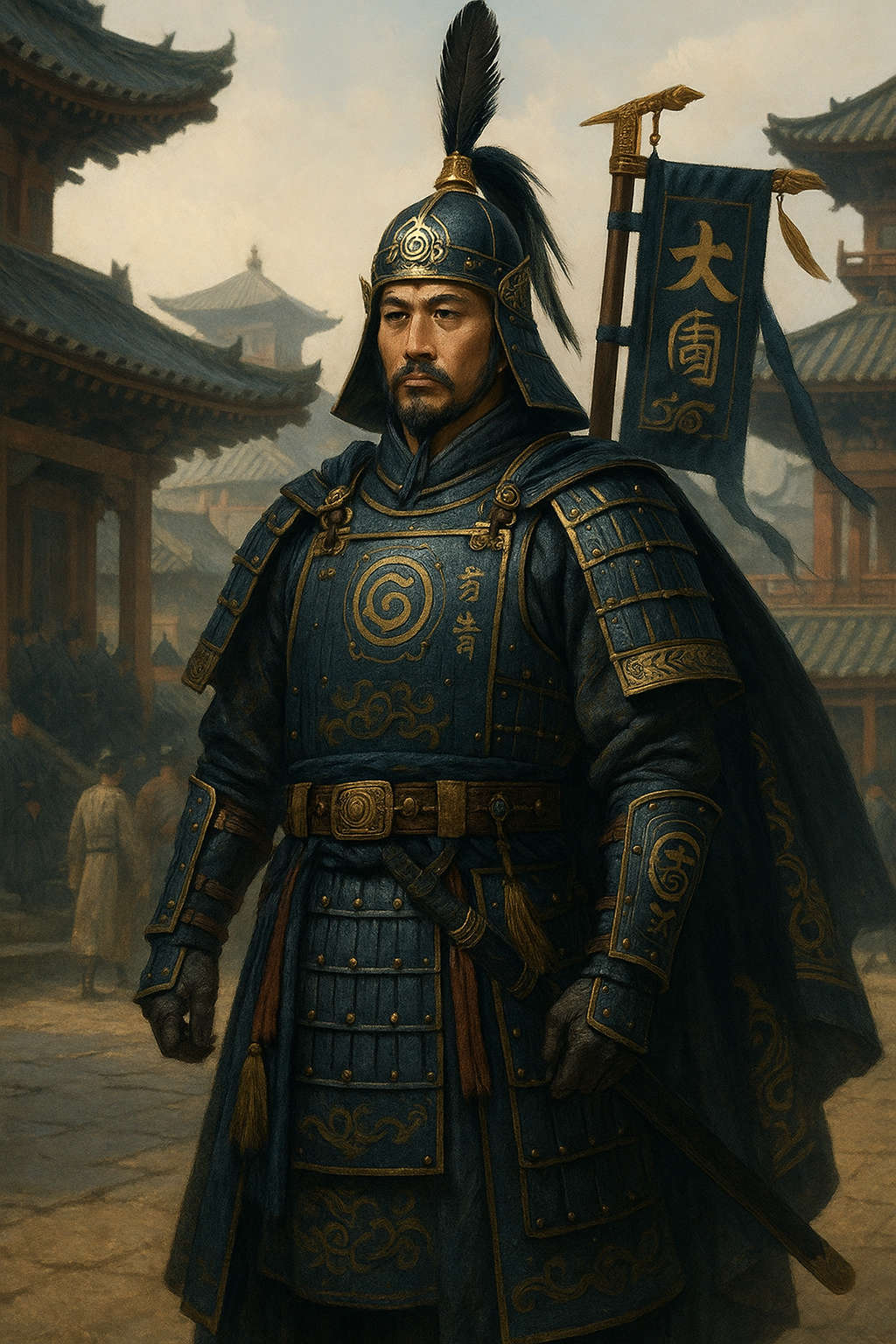
Khaiten's military is small and precise. Its ordinary commissioned face is the Binhgun. The word is written two ways in the Registry, and the clerks have not finished pretending the two writings are a coincidence. Officer-lists use 兵君, "lords of arms": licensed commanders of the spell-legions, trained in formation sigil-casting and in the public theatre of a bannered square. Levy-rolls use 兵军, the host those lords are supposed to move as a single inscription. Spoken, it is one word. A Binhgun officer wears ranked scale, a back-banner of the great-state mark, and a sword that is a warrant as much as a weapon. The rank is a jade-slip office. It is not a house-title, and it is not inherited by a son who cannot pass the formation-examination.
Beneath and beside the Binhgun, licensed spiritbinders hold a field by warding and invocation. Above them, or at an angle the tables do not admit, stand the Chainbound: fewer, oath-tethered, their weapons bound to their souls by scroll. The Binhgun are what Tairen wants a visitor to see in a courtyard. The Chainbound are what Tairen sends when a courtyard is no longer the point. Khaiten does not, in its own language, aim to conquer. It aims to reorder. Vassals who have been reordered have opinions about the difference, and about which writing of Binhgun was on the warrant that arrived first.
Religion
Khaiten does not practise religion in the sense Halcyrite parish-law expects. The Mirror Doctrine is a cosmology one inhabits. The Temple of the Ninth Mirror in Tairen is the spiritual compass of the empire: a place where resemblance is checked, not a place where a god is asked for favours. Seasonal rituals, Mirror Days, and the incense that is tuned to the day's political tone are civic as much as sacred.
Foreign powers often describe this as rigidity. Citizens take pride in being "bound in silk and soul," where discipline is grace. Older echo-cults along the Dorgene stair and blood-tide practices along the Lakh Dai seam survive as folklore until they begin to license themselves. The Registry's patience is finite. The Doctrine's claim is that it is not a faith among others. It is the mirror in which other faiths are asked to stand.
Culture
Khaitenese public culture prizes symmetry, calligraphy, ceremony, and restraint. Fashion, speech, and movement are codified. Silence is an art form. Tables are round. Letters are longer than the silence they interrupt. A person who cannot quote a little law, a little mirror-verse, and a little garden-lore is suspected of having come from somewhere else.
Dress in Tairen is layered, ranked, and coloured in white, red, black, gold, and pink according to registers a foreigner can spend a season failing to decode. The ouroboros-dragon ring appears as clasp, watermark, and the shape a courtier makes with thumb and forefinger when declining a too-square proposal. Cuisine follows orchard, river, and tribute: pale grains, lacquered duck, imported monsoon fruit eaten as a political compliment, and Cenashirene restoratives that court physicians praise without pretending to understand.
Everyday time is ritual time: bell-chimes that dictate social movement; licensed incantation hours, when public spells may be cast; Mirror Days, when citizens wear reflective sashes and walk in silence as a gesture of loyalty. Even the air of Tairen is spoken of as perfumed with regulation-scented incense, tuned to calm or invigorate according to the day's tone. Whether this is architecture, magic, or a well-funded rumour is a favourite overseas argument. Tairen does not settle it.
Economy
Khaiten's economy is a fusion of internal garden-wealth and tributary flow. It produces and exports spell-ink and sigil dyes; celestial brasswork, ritual instruments, and mirror-lacquerware; scrolls, poetic architecture, and licensed enchantments. Trade moves by pilgrimage highways, windboat couriers, and floating harbour courts known as jade slips. The slips are both vessels and documents. A merchant who cannot tell which function is being performed in a given hour is not yet ready for Tairen.
Tribute arrives as Dorgene dream-scrolls, Hmugdam horses and storm-glass, Lakh Dai monsoon silks and lightning-root, Cenashirene medicines, fog-salt, and harbour-contracts. The Registry files all of it as harmony. The senders file it as the price of being left to their own grammars.
Tairen
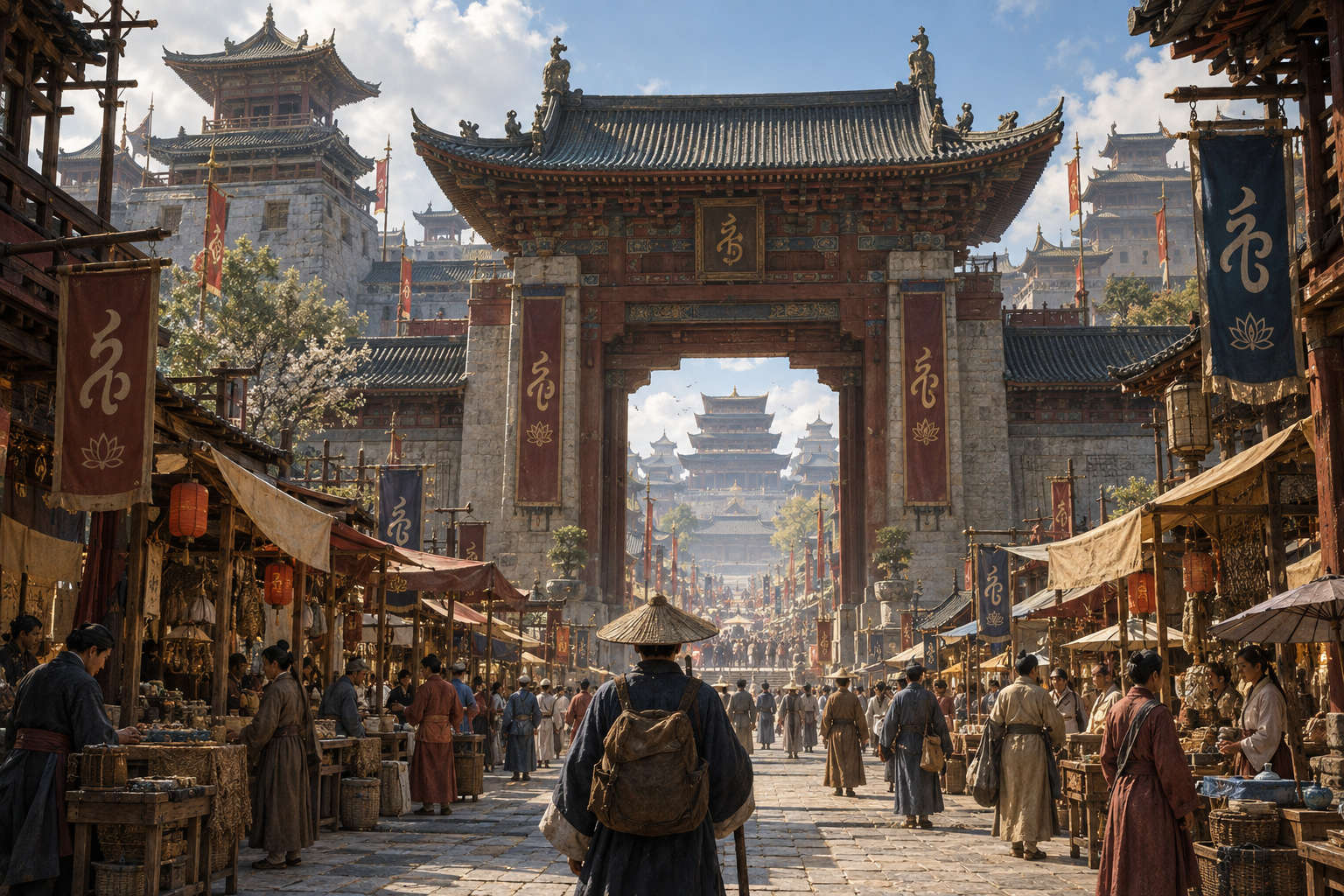
Tairen is Khaiten's capital, Jinrya's documentary heart, and the city most overseas visitors mistake for the whole empire. It sits in the temperate heartland, built according to the ancient Mirror Mandala as a cosmic instrument as much as a seat of power. Concentric rings and radiating waterways open from the Jade Wheel Palace, residence of the Tengshim, famous for eighty-one mirrored halls, whispering corridors, and the Throne of Scripted Heaven. The city is divided into Eight Scroll Precincts, each governed by a Magistrate of Form. Streets are paved in black stone and veined with silver threadlines, used to regulate both mana flow and ritual foot traffic. Public buildings are aligned to celestial stations, or to a surveyor's patience that has learned to look like heaven.
The Zodiac Courts, the Jade Registry, and the Temple of the Ninth Mirror occupy the inner rings. The Scroll-Stone Archives are a subterranean library of living stone tablets: spells, laws, and censored histories that licensed echo-binders may read and others may not. The Hall of Breathless Law is a judgment chamber in which all words are forbidden until a final ruling is spoken, even by the accused. The Vermilion Stair is walked only by a Tengshim, royal exiles, and convicted poets on their final journey. The Garden of Harmonized Silences is a meditation courtyard of sound-dampening spellwork, favoured by archivists and death-mages. Artisans and scholars fill the Ink-Thread Market. Masked monks patrol the Veil District, keeping the boundary between sacred and profane in a city that prefers those words to remain adjacent.
A Khaitenese proverb says that Tairen is not a city but Khaiten made visible. To walk its boulevards is to submit to the beauty of control. To serve in its halls is to shape the mirror of the world. To oppose it, the same proverb concludes, is to vanish from the scroll. The proverb is taught in schools. Vassal wits quote it with a different emphasis.