Flag of Canassar
Overview

The national flag of Canassar, commonly called the Canassarene flag, consists of a golden-yellow seyhindäl (Seyhindalia albafragrans) centred on a horizontal red band on a white field. The flower is shown with six petals, the form used in Canassarene state and religious iconography.
The flag is one of the principal national symbols of Canassar, together with the living seyhindäl. White, red, and yellow have gathered religious, political, and literary meanings; those readings vary by period and community, and historians generally treat them as later interpretations rather than the original reasons for the design. The modern flag uses the flower as its sole emblem rather than a coat of arms. In Canassarene visual culture the six-petaled blossom is widely recognized on its own as a mark of the state.
Design

The flag is a white rectangle crossed at mid-height by a single horizontal red band. Superimposed at the centre is a stylised yellow seyhindäl, taller than the band and extending into the white fields above and below. The flower is shown frontally and radially, with six approximately equal petals around a circular centre. Traditional specifications keep the prominent stamens of the living flower; at small sizes they are often reduced in number or drawn as radial lines and dots. A thin white outline separates the yellow petals from both the red band and the white field.
The emblem is more saturated than the living plant, whose flowers range from ivory-white to pale yellow (as along forest margins in the Naira Nature Reserve). Representing the seyhindäl in yellow or gold predates the modern flag and appears in government insignia, architectural ornament, coinage, and ceremonial objects. Metallic versions generally substitute gold for yellow.
The large central emblem crossing a contrasting band produces an unusual visual hierarchy. At long distances the red band is usually the most conspicuous element; at closer distances the larger and more complex yellow flower becomes dominant. Canassarene vexillological literature sometimes distinguishes the flag's recognition colour from its identity symbol.
Symbolism
Contemporary state publications describe the three colours in broad terms. Religious, literary, and popular traditions supply more elaborate meanings, which have shifted between periods and communities.
Seyhindäl
The seyhindäl is the oldest and least ambiguous element of the flag. Native to Canassar, the flowering plant had religious and ceremonial associations centuries before it became a national emblem. Its six-petaled form is comparatively uncommon among wild plants and appears extensively in Canassarene decorative arts. Within Ohrist traditions, the radial symmetry of the flower has been read as an image of ordered creation, of multiplicity proceeding from unity, and of divine order within living things. Those readings are not doctrinally uniform.
By the early modern period the seyhindäl had a broader civic meaning, largely independent of explicitly religious use. It appeared on public buildings, diplomatic seals, and military standards, and increasingly stood for Canassar itself rather than any particular dynasty or institution.
The yellow of the flag is understood first as the colour of the seyhindäl rather than as an independent political colour. Saturated yellow is a graphic conventionalisation of the flower's naturally pale yellow-white. In ceremonial contexts yellow is commonly rendered as gold, which brings secondary associations with sunlight, dignity, and continuity. Abstract meanings attached to the colour are generally treated as secondary to that botanical identification.
White
White occupies most of the flag's surface and has accumulated the widest range of religious readings. In Ohrist literature it is commonly associated with Ohr, particularly with unity, stillness, and the state preceding differentiation. The uninterrupted white field has therefore sometimes been taken to represent the underlying unity from which more differentiated forms of existence emerge.
A related poetic tradition associates white with the physical environment of Canassar: snow, mist, cloud, and the pale skies of the northern Pacific. That reading became especially prominent in nineteenth-century and twentieth-century landscape painting and nationalist literature. Modern civic descriptions tend to use less theological language, associating white with peace, continuity, and the common country.
Documentary evidence suggests that the religious symbolism of white was systematised well after the earliest known white-field banners.
Red
The red band has attracted the greatest variety of interpretations. Unlike the seyhindäl, red is not generally understood as a depiction of a particular natural object. Its most widespread traditional association is with living humanity: blood, bodily warmth, fire, and mortal existence. In that reading the red band is the inhabited human world crossing the otherwise white field.
That association supports one of the best-known theological readings of the flag, in which white represents undivided existence or Ohr, red represents embodied life, and the golden seyhindäl occupies both. The flower's placement across the boundary between red and white has been taken to express continuity between the sacred and material worlds. The interpretation is particularly common in modern Ohrist art and is probably retrospective: there is little evidence that the geometry of the flag was originally constructed to express this scheme.
Red acquired further associations with sacrifice during periods of warfare and political upheaval. Patriotic literature frequently described the band as the blood of previous generations, especially after major conflicts. That reading remains widespread and is generally treated as a later nationalist development.
The red band
The horizontal band itself has occasionally been assigned meanings distinct from its colour. A longstanding literary interpretation identifies it with a path, a horizon, or continuity across the land, with the seyhindäl as Canassar growing upon it. Maritime readings instead compare the division of the white field to a distant horizon, an association especially common in coastal communities and among the Canassarene sailing tradition. Neither explanation is generally accepted as the definitive historical origin of the band.
The band's strongest early function may have been practical. Earlier yellow-and-white seyhindäl banners were hard to distinguish under bright skies and at a distance. A darker horizontal element increased the visibility of an otherwise pale design while leaving the established yellow flower unchanged. That practical account and later symbolic readings are not treated as mutually exclusive: flag elements often acquire meanings apart from the circumstances that first produced them.
Religious interpretations
Ohrist writers have produced numerous symbolic readings of the flag, none of which has the status of an official theological interpretation. The most influential is sometimes called the three-fields interpretation, although the flag is not a conventional tricolour. It treats the composition as three conceptual elements: the white field as transcendence or undivided existence; the red band as material and mortal existence; and the golden seyhindäl as ordered life arising within and extending beyond both.
That the flower crosses the edges of the red band is central to the reading. A blossom contained entirely within the band could be taken to belong only to the material world; its petals occupy both red and white space.
Some commentators extend the same geometry to the constitutional symbolism of the Canassarene state. Gold has occasionally been associated with the outward-facing Sun-Aspect, and white with the inward-facing Moon-Aspect of the Twin-Aspect monarchy. Those readings are comparatively recent and are generally regarded as constitutional allegory rather than intrinsic symbolism of the flag.
Cultural significance
The combination of red, white, and yellow is widely used in Canassarene civic design, though individual national symbols do not always employ all three colours. Government publications frequently use red as a structural or accent colour and yellow for seyhindäl emblems. Ceremonial representations commonly substitute metallic gold for yellow. White remains especially prominent in diplomatic and religious contexts. On National Day the flag appears on public buildings and private homes, usually with restrained, orderly placement.

The national passport is a notable official use that does not reproduce the flag's white field. Its charcoal-grey cover carries the red band and a gold seyhindäl, with the country name above the emblem and the word "PASSPORT" below. Grey stands in for the flag's white; the flower and the band remain the identifying marks, in keeping with the broader convention that the seyhindäl may function independently as an emblem of Canassar.
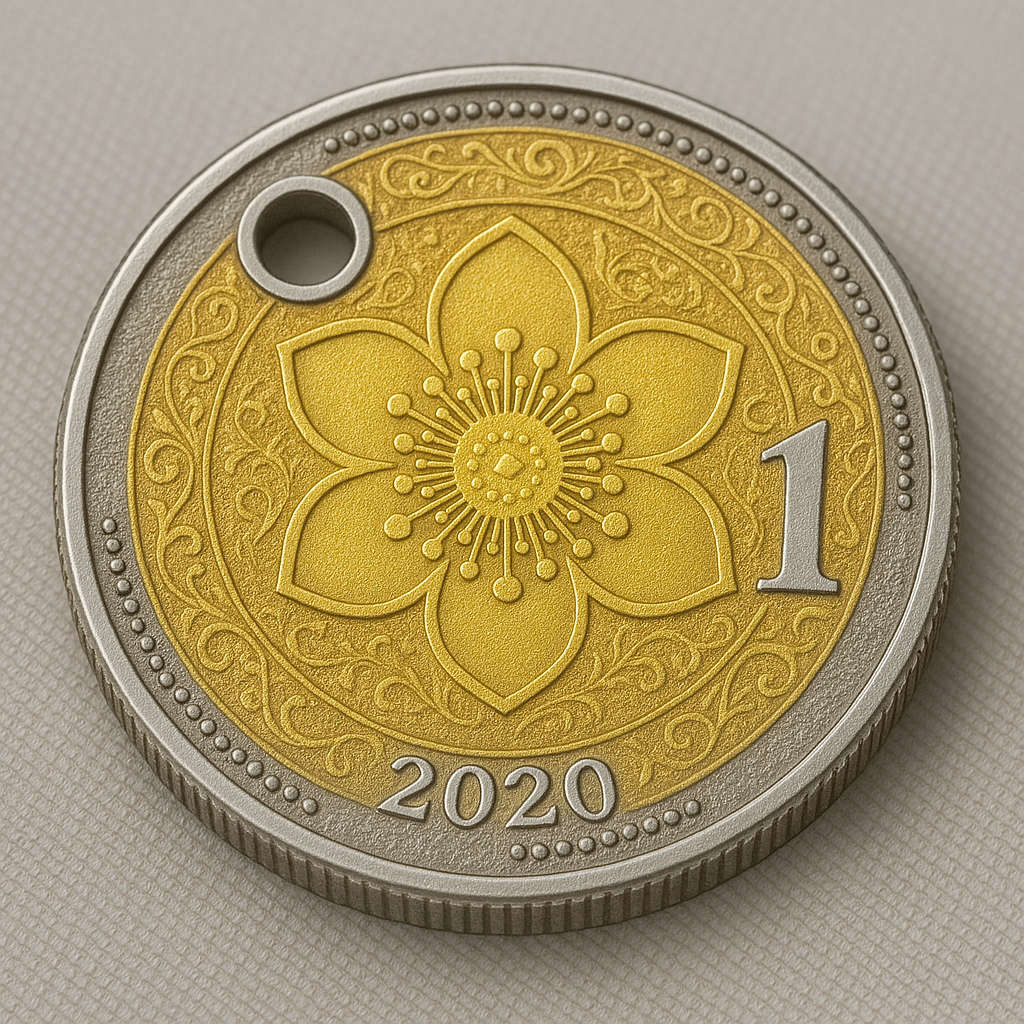
On coinage the emblem is commonly struck in gold-coloured metal. A 2020 one-rin piece shows the six-petaled flower on a gold core within a silver outer ring, the stamens rendered as a raised sunburst and the field behind the petals filled with scrolling vegetal engraving.
The flag's arrangement has also produced an incidental resemblance to a wrapped gift: the horizontal red band reads as a ribbon and the large golden seyhindäl as a decorative bow. The comparison is common enough to appear in popular humour and seasonal commercial design. It is not part of the flag's official symbolism.
Vexillology
The Canassarene flag is usually classified as an emblematic horizontal-band flag rather than a conventional triband. Horizontal bands are a widespread organising device in national flags, but the broad white field, narrower contrasting central band, and oversized botanical emblem give this composition a distinctive silhouette. The use of a native flower also places the flag among national designs that draw their principal emblem from geography and living things.
Canassarene vexillologists have particularly emphasised the flag's separation of visibility and identity. The red band supplies the strongest chromatic contrast and permits recognition at a distance, while the seyhindäl supplies the specifically Canassarene content. The arrangement therefore allows the national flower to keep its traditional yellow coloration without relying on yellow–white contrast for overall visibility. In that respect the addition of red did not replace the older yellow-and-white visual tradition; it provided a contrasting framework around it.