Tuma-tön
Overview
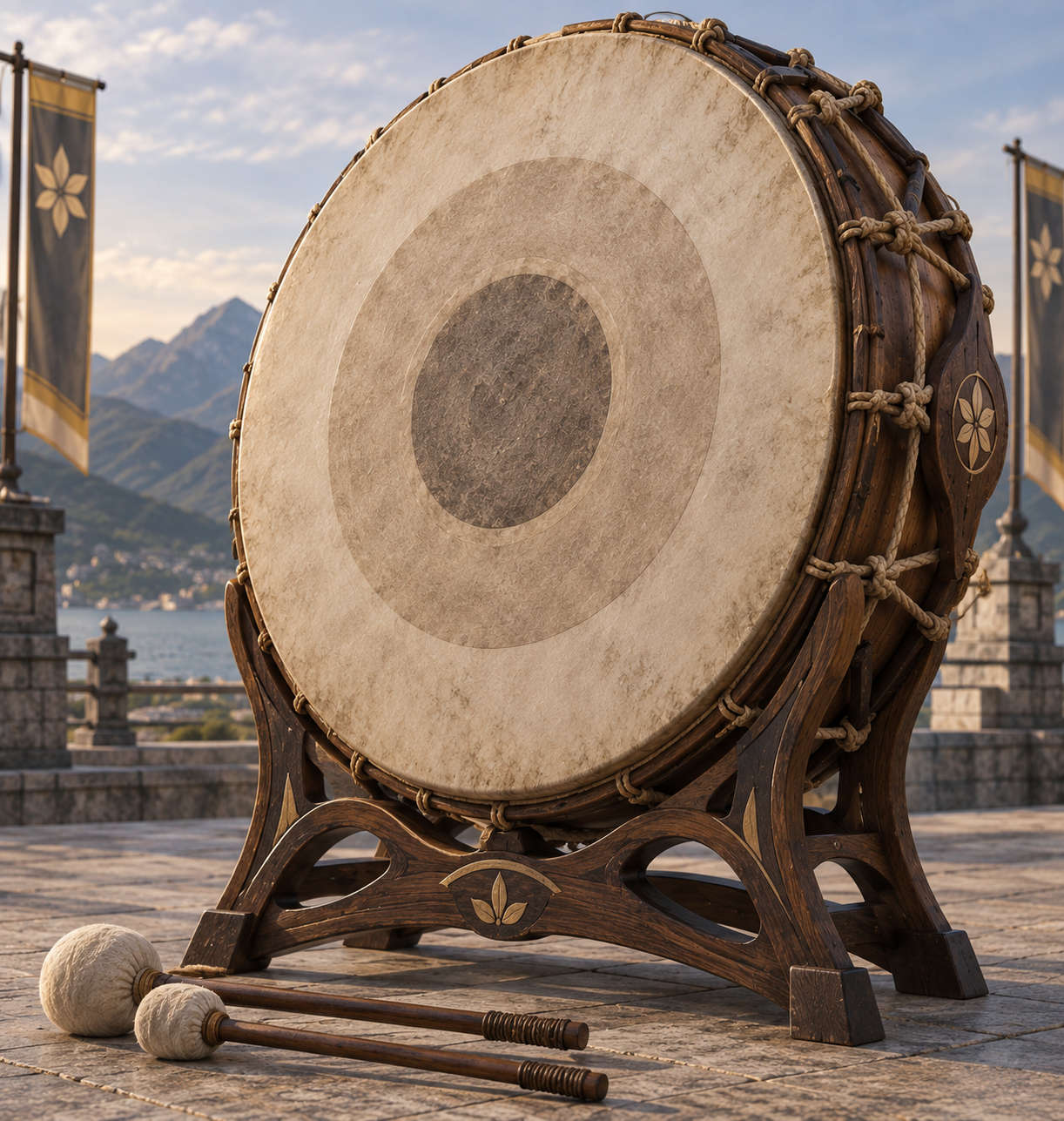
The tuma-tön is a traditional Canassarene frame drum distinguished by its large diameter, shallow body, and layered circular membrane. It is among the largest traditional percussion instruments of Canassar and is particularly associated with festivals and other occasions that permit large-scale public music, including Mälloc. Unlike the comparatively light timbres of instruments such as the şiyaran and fyu-curil, the tuma-tön produces powerful low-frequency strokes intended to carry across large indoor and outdoor spaces.
A distinctive feature of the instrument is its graduated membrane. One or two additional circular layers of hide or tightly stretched textile are applied over the central portion of the primary drumhead, producing zones of differing thickness across the playing surface. The tone therefore varies substantially according to where and how the membrane is struck, so that a single instrument can produce deep resonant strokes, shorter muted sounds, and comparatively sharp peripheral attacks.
Related articles: music of Canassar; festivals; fyu-curil; şiyaran.
Name
The name is a lexical compound of tuma ("drum") and tön ("big" or "large"), conventionally translated as "big drum." In Canassarene compound formation the head noun precedes its qualifier, so tuma is followed by tön.
Tuma is also used more generally for membrane drums, while tuma-tön refers specifically to the large layered form. Despite the instrument's distinctive construction and performance practice, its conventional name is descriptive rather than ceremonial.
Construction
A tuma-tön consists of a broad, shallow wooden frame over which a membrane is stretched under considerable tension. Instruments vary in size, although the traditional form is sufficiently large that it is normally supported on a wooden cradle or stand rather than carried by the performer.
The primary membrane is traditionally made from prepared animal hide, although tightly woven textile membranes are also known. Over this are attached one or two progressively smaller circular layers, generally no more than approximately 2 mm thick individually. A typical three-layer construction therefore consists of a single membrane across the entire frame, a second layer covering part of its central area, and a smaller third layer at the centre.
The resulting surface is visibly concentric, but the rings are not merely decorative. Additional material increases the mass and damping of the central portions of the membrane and alters their response to being struck. The comparatively thin outer portion remains more freely resonant, while the increasingly loaded inner portions produce progressively darker and more damped sounds.
The wooden frame itself may also be struck during performance. This practice is sufficiently established that the frame is treated as part of the playable instrument rather than merely as structural support.
Sound and playing technique
The characteristic sound of the tuma-tön is a deep, rounded thom or dum, accompanied by a relatively controlled decay. Its large membrane gives the instrument considerable acoustic power, but traditional playing makes use of a much wider range of sounds than repeated central strokes.
Different areas of the drumhead possess contrasting acoustic properties. The outer, single-layer membrane produces the most open and lively response, with a relatively strong high-frequency attack. The intermediate, double-layered region gives a darker and more rounded tone. The heavily loaded central area is considerably more damped and may produce a short, low thud rather than a sustained resonance.
The muted central response is incorporated into tuma-tön technique rather than treated as a defect. Players alternate between resonant and damped regions to articulate rhythmic patterns, and may additionally strike the rim or wooden frame to obtain dry, sharply defined sounds.
The instrument is usually played with padded beaters, although the hardness, striking angle, and position of the beater substantially affect its tone. Skilled performers therefore control not only rhythm and dynamics, but also the timbral character and approximate perceived pitch of individual strokes. The tuma-tön is not a melodic instrument and does not provide independently tuned notes in the manner of a xylophone or similar pitched percussion. Its different membrane zones nevertheless allow comparatively fine control over the tonal character of a rhythmic passage.
Musical use
The tuma-tön occupies an unusually forceful register within traditional Canassarene music. Many Canassarene instruments favour relatively intimate sounds, particularly plucked strings, flutes, and other instruments suited to smaller ensembles. The tuma-tön instead developed in contexts where considerable volume was desirable or socially appropriate.
It is especially prominent during Mälloc, when large public gatherings and comparatively boisterous musical performances contrast with the greater restraint expected in many other settings. Groups of tuma-tön players may provide the principal rhythmic foundation for outdoor performances, processions, and communal celebrations.
The instrument's loudness is nevertheless traditionally accompanied by an emphasis on control. Beginner performance may rely primarily on maintaining the underlying pulse, while more advanced playing employs contrasts between the outer, intermediate, and central membrane zones, frame strikes, damping, changes in striking force, and complex rhythmic figures. Virtuoso playing is consequently distinguished less by maximum volume than by the ability to produce clearly differentiated sounds from the same instrument while maintaining a rhythmic cycle.
Tuma-tön may be performed alongside smaller percussion instruments and, in some settings, melodic instruments such as the fyu-curil. It does not form part of a single standardized traditional Canassarene ensemble, and its use varies according to occasion and regional practice.
Cultural significance
Because of its size and acoustic power, the tuma-tön is among the most visually and aurally conspicuous traditional instruments in Canassar. Its presence commonly marks a deliberate departure from the quieter scale of everyday music.
Traditional ideas surrounding accomplished tuma-tön performance place particular value on the controlled use of this power. The ability to produce a loud stroke is considered elementary; greater skill is demonstrated through changes in articulation, resonance, and dynamics, particularly through rapid movement between the differently loaded regions of the membrane.
This has contributed to the tuma-tön's reputation as an instrument that appears mechanically simple but requires considerable practice to play expressively. Its layered drumhead, originally a practical means of altering the response of a large membrane, has consequently become the instrument's most recognizable structural feature.