Cenashir
Overview
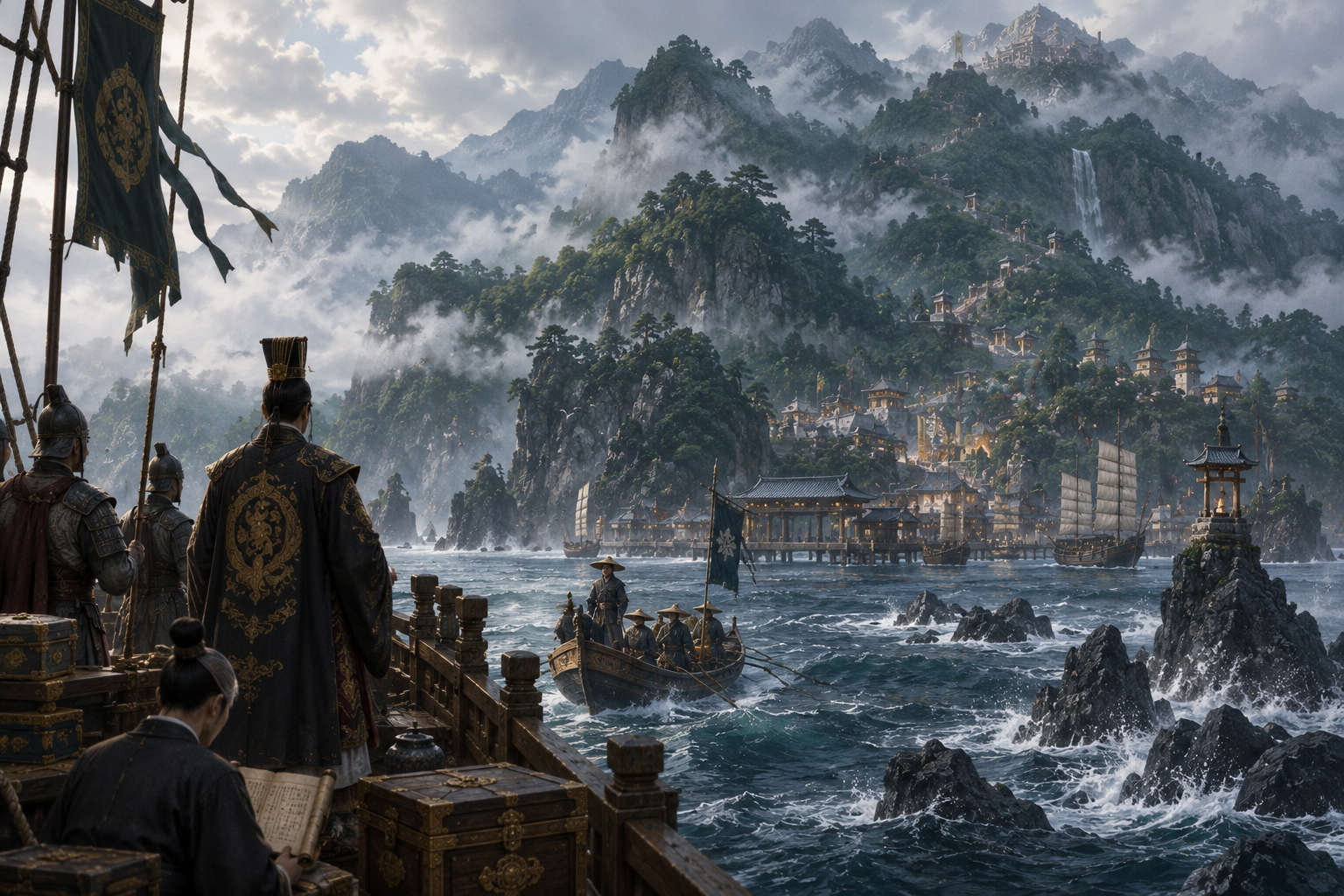
Cenashir is the island country of western Jinrya, a highland island west of Hmugdam and Khaiten, cut off from both by the Knifewaters. It is numbered among the petals of the Mandala Concord and drawn inside the same outline as the main mass, but it is not a stair-province of either neighbour. It is a mountain island with its own seasonal calendar, its own medicine, and a body of shadow-law that Tairen files, uneasily, as courtesy. Khaitenese travellers who expected a wetter, quieter Khaiten find instead a people who look eastern to Halcyr and foreign to Tairen: ritual-dense, landscape-loyal, and politely uninterested in being mirrored.
Khaiten numbers Cenashir among the celestial cycle because an inhabited island in the Knifewaters is too close to ignore and too maritime to annex as ordinary ground. Protection is the Concord's word for that fact. Cenashir's word is the Knives themselves. Tribute moves as medicines, fog-salt, and harbour-contracts. Influence moves as a pair of ceremonial Aspects who can receive a jade slip without becoming a Magistrate of Form.
Geography
Cenashir is a highland island. Water stands on every side. The Knifewaters, named on the strait between the island and Hmugdam's western grass, are a narrow, cold, frequently white sea that cuts hulls and arguments with equal indifference. South and west the water opens further. East, beyond the strait, the main Jinryan mass begins. North is more sea, then the iceward band.
On the ground the island is more country than foreign maps admit. A central alpine spine divides a fog-held western upland from an eastern harbour basin, where most of the population lives and where visiting jade boats actually tie. Southern wetland fringes and a scatter of lesser islets complete a maritime habit that Khaitenese charts flatten into "highland," as if mountain were the whole of an island. The Cenashir Stair is the sacred switchback of that alpine spine: terraces, fog-bells, and the high sanctuary at which the Aspects are shown to the year. It is not the capital. Tairen sometimes files it as if it were, which island wits treat as a garden mistake about stairs.
Government
Cenashir is a ceremonial dual monarchy under the Twin Aspects, a Sun-Aspect and a Moon-Aspect who embody the state's two faces and do not, in ordinary years, govern. Practical power sits with a compact assembly of harbour houses, physician-guilds, and shadow-law benches: the people who keep the basins fed, the Knives charted, and the contracts that Tairen cannot quite read. Concord etiquette wants a single Warden and a jade signature. What it receives is a pair of Aspects to bow to and a shadow-bench to negotiate with, after the incense has been lit and the season named.
Tribute is medicinal preparations, fog-salt, and harbour-contracts that the Jade Registry rates as exemplary and Cenashir rates as the price of being left an island. Hostages, when they are sent, are younger physicians and shadow-clerks who learn Tairen's silence and return speaking two legal languages at once, neither of which is the other's.
History
People have lived on the island longer than the Concord has had a name for them, and the Scroll-Stone Archives are thinner on the subject than on Dorgene's dreams or Lakh Dai's gourds, which is Tairen's way of saying the island kept its own telling. The Scroll Purge of the Second Cycle took whatever first name the stair had. Cenashir is the Third-Cycle spelling, filed when the Court of Mandala needed a petal for the western water. Local memory prefers the island's own seasonal names and treats the Registry word as a garden courtesy that happens to be useful in harbour paperwork.
The Concord of 3E 1080 did not so much bind Cenashir as notice a maritime neighbour it could not unfold. Khaitenese windboats already knew the eastern basin. Hmugdam already knew not to swim the strait for glory. What changed was etiquette: Aspects who could be addressed, a tribute that could be dated, and a place on the floral mandala for a country charts had always shown as lonely. The island remained, in Tairen's private letters, the petal that does not quite match the others.
Magic and law
Cenashir is renowned, even in Tairen, for two crafts the Mirror Doctrine handles badly. Medicine here is a seasonal, landscape-bound art: alpine simples, harbour-marin restoratives, and physician-rites timed to the island's own year rather than to licensed incantation hours. Shadow-law is the island's other export and its other opacity: a contract-magic of hidden clauses, intelligence-oaths, and judgments that take effect in the unlit half of a name. Khaitenese inspectors who ask to see the diagram are shown a harbour, a season, and a smile. The licences that return to the Registry describe "coastal courtesy" and "unrated pharmacology." The Knives continue not to read them.
Belief is a synthesis of ancient seasonal telling, landscape obligation, and a dual sovereignty of sun and moon that is older than any jade slip. Mirror courtesy is learned for visitors. It is not the island's first language. An island heresy, Tairen sometimes calls it. The phrase tells more about Tairen than about the island.
Culture
Cenashirene life is season-timed, harbour-facing, and loyal to particular slopes in a way that garden people experience as mystery and island people experience as ordinary sense. Dress is layered, regionally marked, and brightened for the eastern basin; alpine cloth and oilskin take over as soon as the Stair begins. Cuisine is marin and mountain together: fog-salt fish, wetland grain, alpine tea, and restoratives that visiting Khaitenese eat as medicine and locals eat as supper. Music is bell, long telling, and the harbour drums that name a change of season more loudly than any Registry calendar.
The characteristic vice, from a Magistrate of Form's chair, is opacity pretending to be etiquette. The characteristic virtue, from an Aspect's, is that a country which can be numbered as a petal without being read as a mirror is still a country.