Hmugdam
Overview
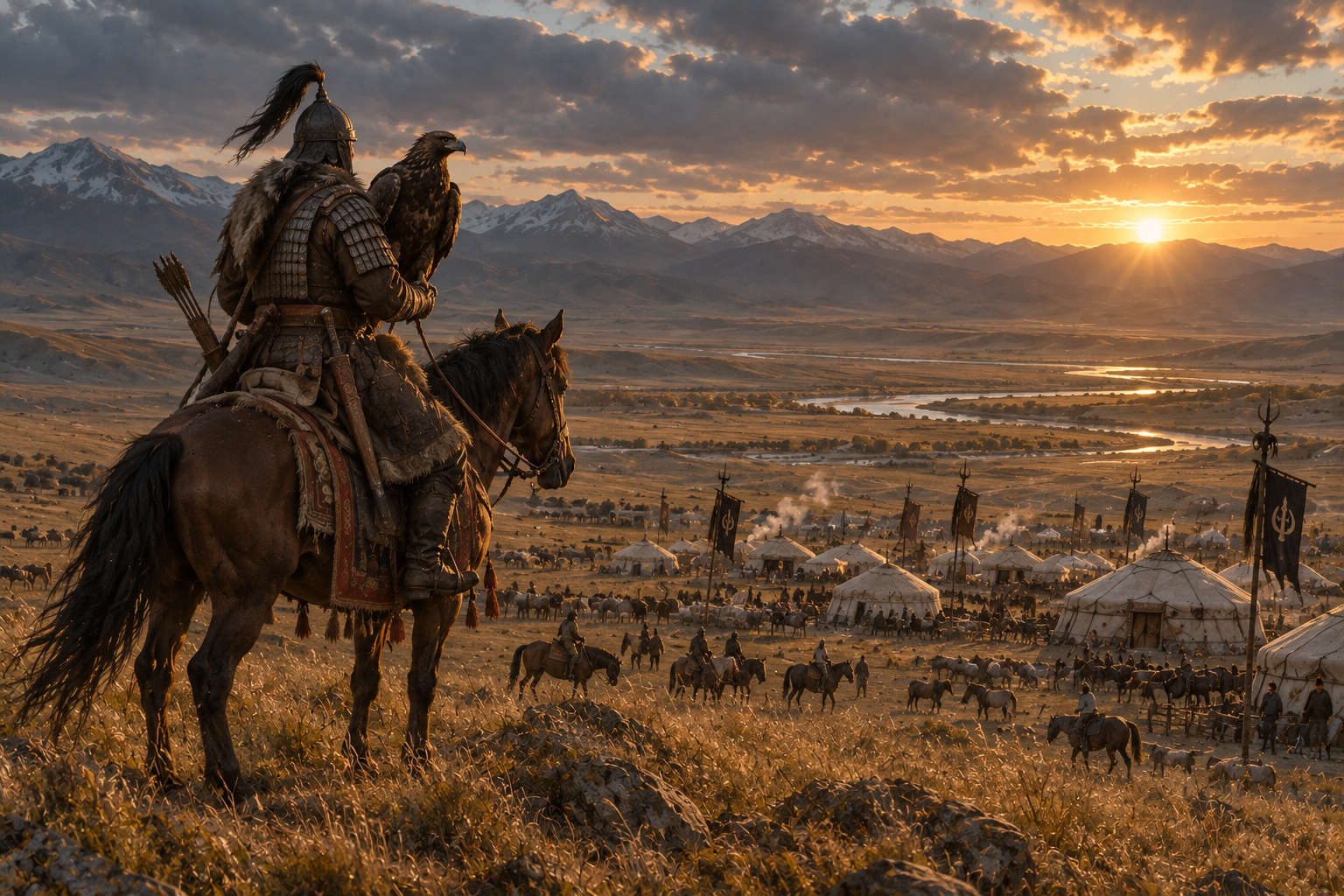
Hmugdam is the steppe country of northwest Jinrya, grass that binds highland Dorgene to temperate Khaiten and looks west across the Knifewaters toward the island of Cenashir. It is a confederacy of storm herders, thunderbinders, and free riders bound by oath and bone rather than by a capital in the Tairen sense. The Stormring on the grass that faces Khaiten is the seasonal assembly at which banners gather, oath-bones are recut, and tribute horses are counted before they go south into garden country.
Khaitenese court histories still remember the western steppe as an enemy that was folded into the mandala. Older Registry files call that folding pacification. Hmugdam calls it an oath. The difference is not academic. A petal that can recut its own bone is a petal that remembers being a storm.
Foreign accounts, especially Tairen ones, describe Hmugdam as a desert of thunder. The country is steppe, grass and wind and the kind of sky that makes a garden inspector feel unclothed. The "desert" is a temperate prejudice about places without orchards. Comparative geography has sometimes reached for a horse-nomad analogue. Hmugdami reach for the herd, the bone, and the storm, and do not particularly care what the comparison is for.
Geography
Hmugdam occupies Jinrya's northwest grass. The iceward north meets Dorgene's highland and the last of the iceward wind. The west looks onto the Knifewaters, the strait that makes Cenashir an island rather than a neighbour one could ride to. The southeast, Stormring country, is the seam with Khaiten: inspection posts, horse-fairs, and a pilgrimage highway that Tairen pretends is a civilizing road and the banners treat as a convenient track for going to sell weather.
There is no single city that a jade slip can name as capital. Encampments move. Bone-posts mark wells, storm-caches, and the graves of oaths that were not recut in time. The Stormring itself is a circle of standing weather-stones and tether-rings, empty most of the year and deafening when it is not. Thunderbinders say the stones remember every gathering. Khaitenese geomancers have asked to survey them. The answer has been, so far, a storm.
Government
Hmugdam is a pact of banners, not a throne. Each banner is a herd, a storm-right, and a set of bones on which the names of living riders and dead obligations are cut. Disputes between banners are settled at the Stormring by recutting, by race, or by a thunder-duel that Tairen classifies as unlicensed working and Hmugdam classifies as weather.
The Thunder-Speaker is the confederacy's voice for a gathering, not its sovereign. The office lasts as long as the assembly, or as long as the storm that seated it. What Tairen wants is a signature. What it receives is a bone-oath carried south by a rider who may or may not still hold the right to speak when the jade slip is read in the Zodiac Courts.
Tribute is horses, storm-glass, and a hostage-scroll of bone-oaths kept in the Jade Registry. The Registry files the scroll as harmony. The banners file the horses as rent on a peace they can still smell.
History
People have herded this grass longer than the Mandala Concord has had a name for them, and longer than Tairen's habit of numbering petals. Thunder-wars along the temperate seam are the first events both sides agree happened, though they agree about little else. Khaitenese annals present a sequence of inspections, defeats, and a folding into celestial cycle. Hmugdam songs present a sequence of storms, a winter in which the garden people learned to fear grass, and an oath cut on a bone that still exists, or is said to, at the Stormring.
The Concord of 3E 1080 made Hmugdam addressable in Tairen's hand. It did not make the banners into magistrates. Later recuttings of the oath have coincided, with a regularity Tairen finds distasteful, with weak Sovai, bad harvests in the west precincts, and years when the Dream-Tax arrived late from Dorgene. Whether Hmugdam causes those years or merely notices them is a favourite argument in the Zodiac Courts. The steppe's position is that thunder notices first.
Magic
Hmugdam magic is storm-work. Thunderbinders drive weather as a herd: calling, turning, and, when a banner needs a border, pinning a squall to a bone-post until the neighbouring inspector takes the hint. The work is loud, collaborative, and insulted by the idea of a licence hour. Formation sigil-casting, the Khaitenese military art, is respected as a garden trick that happens to kill people. It is not imitated. A rider who tried to mirror a storm on parchment would be asked, kindly, whether they had lost their horse.
Storm-glass, a tribute specialty, holds a charge of thunder and releases it as a dry crack useful in Tairen for theatre, signalling, and the intimidation of clerks. The banners regard the export as a joke that pays. The Registry regards it as a licensed product. Both can be true for as long as the glass does not go off in the Ink-Thread Market.
Culture
Hmugdam life is oath-timed, horse-loud, and careful about which bone is being named. Dress is layered felt, storm-cut cloaks, and lashes of glass-bead that catch lightning in stories if not always in weather. Greetings are a palm to the chest and a glance at the sky: I have a name, and so does the cloud. Cuisine is herd-fat, blood-sausage, sour milk, and garden grain eaten as a political compliment when the highway is open.
Speech is clipped in ways Khaitenese call crude and Hmugdami call honest. Silence, in Tairen an art, is here a pause before a recutting. Music is drum, horsehead string, and the long shout that tells a herd a storm has been bound or has declined to be. The characteristic vice, from a Magistrate of Form's chair, is the refusal to stay in one parish. The characteristic virtue, from a rider's, is that the grass was never a parish to begin with.