Ardalia
Overview
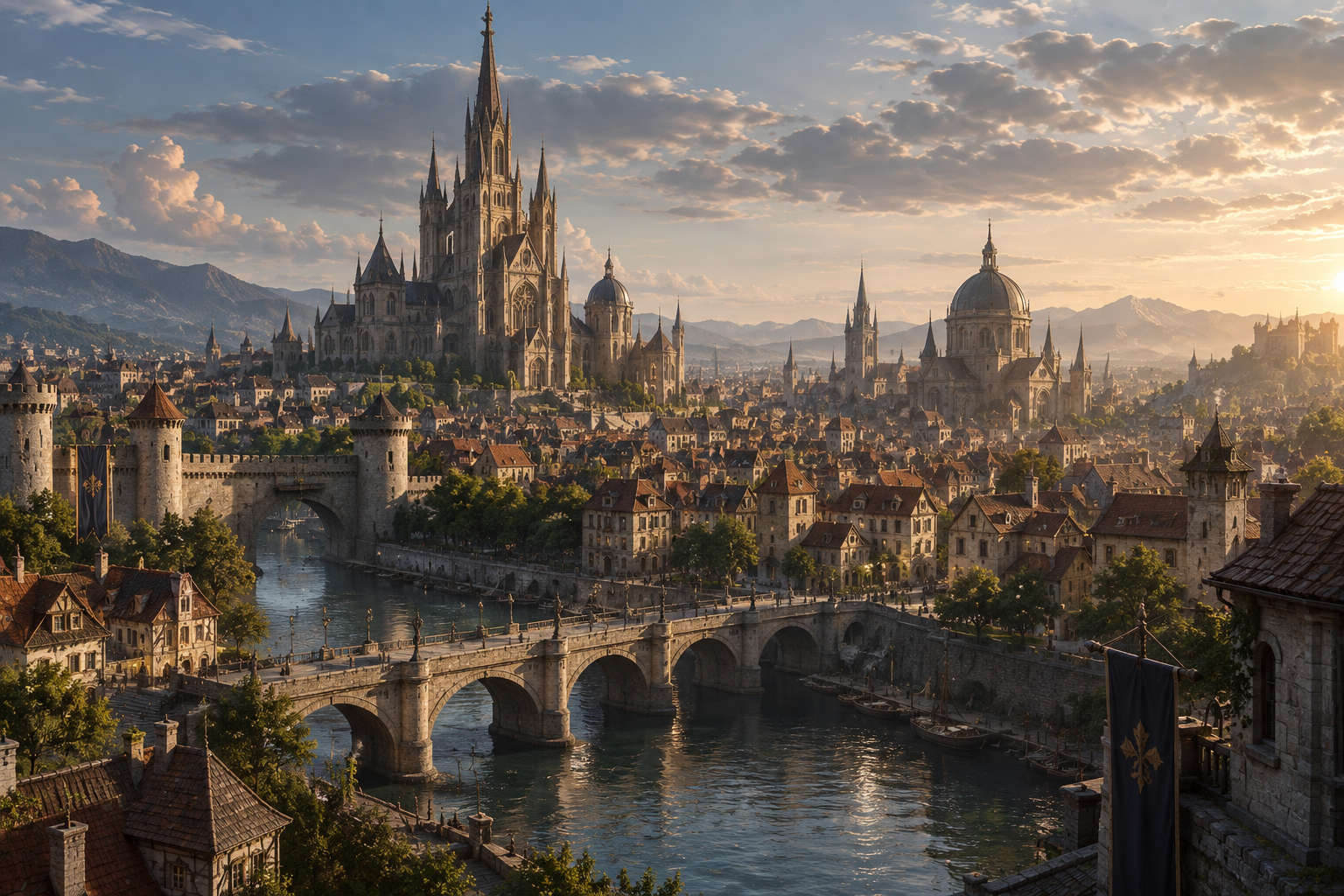
Ardalia is a country of central Halcyr, occupying the temperate middle of that compact northwest landmass: river plain and orchard, with a short eastern lobe facing open water. It is the seat of the Halcyr Dominion, a federated theocratic bureaucracy whose capital, Viremdane, concentrates the Senatirum, the Concord Bureau, the principal collegia of licensed magic, and a density of parish towers that foreign travellers often mistake for a single endless city of bells.
Ardalia is the Halcyrite society most often described first. Its chancery language, Concord registers, and river-law furnish the default vocabulary through which many overseas accounts introduce the landmass. That prominence is not the same thing as rule over Halcyr. Karyosk lies immediately west, on the steppe. Norskyla lies immediately north, on the highland. Both remain outside the Dominion's effective sovereignty, and both have spent centuries explaining, sometimes at sword-point, that "Halcyr" is a landmass rather than an Ardalian possession. Inside Ardalia, the distinction is harder to hear. School maps paint the Vire gold, the west in cautionary hatching, and the north as a margin of highland from which interesting weather and difficult people arrive.
The country's reputation abroad is that of a land of magic and sorcery in the theatrical sense: white-stone collegia, licensed thaumaturges in collared coats, processions of lumen-glass, and a countryside in which even village wells may carry a Concord stamp. The theatrical sense is not false. It is incomplete. Ardalian magic is powerful because it is boring in the way that good bridges are boring. It has been made into an examination subject, a tax category, and a parish duty. That, more than any single spectacular working, is what the Dominion exports.
Geography
Ardalia occupies the central temperate belt of Halcyr, drained principally by the River Vire. The Vire rises in the Tharnspire foothills of the north, where highland Norskyla gives way to temperate ground. It runs south through the heartland, past Viremdane, and reaches pelagic water in a managed estuary. Immediately beyond that mouth is Draugormyr sea, not Halcyrite desert. Flood meadows, towpaths, and a lattice of older oxbow lakes give the basin its characteristic look: a green country that has been rewritten by tow-horses, weirs, and licensed water-mages for so long that "natural" and "maintained" are no longer separate ideas.
The eastern lobe, Ostelane, is the same temperate climate rather than a separate southern vineyard belt. Limestone hills, citrus terraces, and older civic republics sit here, looking onto the Valebright Sea, a named stretch of open water due east of the lobe. Calverenne, the principal harbour, is Ostelane's port on that sea: the place most foreign delegations arrive if they prefer not to come overland through Karyosk. West of the Vire there is no Ardalian maritime fringe. West of the Vire is Karyosk.
The northern marches, branded Tharnwatch in military geography, face the Tharnspire and, beyond it, Norskyla. The seam is highland against temperate ground. Passes are few, rune-watched from the far side, and closed by people who do not regard a Dominion road-gazette as a reason to open them. The Skarn Vales, fused in the Flamewar, belong to that same seam rather than to a southeastern mountain country that does not lie in that direction. They are administered as a cautionary reserve as much as a province.
A primary knot of the Sundering Leychain underlies the Vire at Viremdane, with secondary knots under Ostelane and the Tharnwatch collegia. Concord geomancy treats this as providence. Karyoskian pamphlets treat it as the real reason the Dominion can afford so many rules.
Government
The Halcyr Dominion is a federation of duchies, city prefectures, collegiate territories, and Luminarchate sees, theoretically balanced and practically centred on Viremdane. Its theocratic character does not mean that prelates command armies in the ordinary sense. It means that law, liturgy, and licensed magic are treated as three faces of one public order, and that a statute which cannot be preached, registered, and enforced is considered unfinished.
The Senatirum is the high chamber. Its benches are divided among ducal voices, collegiate voices, and Luminarchate voices, seated in white stone under a ceiling whose painted cosmology is also a Concordian diagram of permitted workings. Debate is slow, recorded, and addicted to precedent. The Senatirum does not claim to invent the law of the Weave. It claims to keep it.
The Concord Bureau is the Dominion's most characteristic institution and its most resented export. It examines, licenses, inspects, and, when necessary, unmakes practitioners. A Concord licence is a public document: name, rank, permitted classes of working, collegium of origin, and a seal that can be read by any parish lumen-keeper. Unlicensed spellcraft is not merely illegal. It is classified as a kind of forgery, a counterfeit of a public craft. The Bureau's travelling pairs—one inspector of workings, one clerk of paper—are a stock figure in Ardalian comedy and Karyoskian tragedy.
Ranks in Concordian practice run, in outline, from Aspirant through Licensed and Concordant to the rarer Senatir grades reserved for those who may teach, judge, or close another practitioner's book. The ranks are not a church hierarchy, though Luminarchate schooling supplies a large share of candidates. They are a civil service of the Weave.
Local government retains a feudal grain that Unification never quite milled away. Dukes keep courts. City prefects keep ledgers. Parish lumen-keepers keep the lamps and the gossip. What has changed since 2E 713 is that all of them can be reached, in the end, by a letter from Viremdane, and that the letter will be answered on Concord paper.
History
Ardalian river towns were already literate and quarrelsome in the Stone-Scribed Period, cutting property marks, flood-records, and divine names into the same stones they used for weirs. Ancestor cults and early experiment with the Leychain produced both the first collegia-in-embryo and the first disasters that later sermons still cite by parish. The country did not yet think of itself as a country. It thought of itself as a family of rivers that happened to flood in the same week.
The Twilight Concord, which Halcyrite chroniclers take as the opening of the Second Era, was an Ardalian settlement before it was an export. Magi, prelates, and the greater houses agreed that unlicensed working had become a public weather: it blighted neighbours who had not been consulted. The Concord's original text, the White Concordance, is still read aloud at the installation of a new Senatir. It is a short document. The libraries of commentary are not.
What followed was a long attempt to make the rest of Halcyr look like the Vire. Concord registers, parish towers, and feudal contracts of a new, magically witnessed kind moved north along the Tharnspire roads and west into Karyosk. Some neighbours took them as civilization. Some took them as a tax. The Unification of the Dominion in 2E 713 made the export a state. Duchies that had been allies of convenience became prefectures with banners they were no longer allowed to furl. Ostelane kept its festivals and lost its right to license its own magi. Calverenne kept its harbour and gained a Concord house on the quay that drinking songs still call the fifth tide.
Ardalia's later history is in large part the history of discovering the limits of that state. The Treaty of Veltragh (2E 806) confirmed that Karyosk, next door, would not be examined. The Flamewar of the Skarn Vales (2E 941–948) confirmed that Leychain nodes could still unmake a countryside even when every participant held a licence, a house-seal, or a saga-right. Reconstruction of the Vales became a Dominion morality play: glassed earth as the cost of pride, and licensing as the only known mildener, if not a cure. Norskylic thanes, who had helped seal the Ninefold Gate before there was a Dominion, have never been persuaded that a Viremdane stamp is an improvement on a carved oath.
In the present era, Ardalia remains the most administratively thick country on Halcyr, the most widely copied, and the most frequently accused of mistaking its own habits for the shape of the world.
Magic
Concordian Spellcraft is the Ardalian name for a tradition that treats a working as a reproducible public act. A licensed procedure has a diagram, a spoken or gestured key, a stated yield, and a stated waste. The caster is responsible for all four. Magic, in this account, does not create unrestricted energy or matter; it rearranges what the Weave and the world already hold. The rearrangement is expected to be reversible in principle, inspectable in practice, and boring to live beside.
Collegia occupy the Leychain towns and a few stubborn hill-sites that refuse to be quiet. They teach theory, law, and a practical circuit of weather-warding, healing, agronomy, metallurgy, and the closing of other people's mistakes. The most famous, in Viremdane, is less a single campus than a quarter of the city: cloisters, lumen-glass halls, examination yards, and a river-gate at which unsuccessful candidates have traditionally thrown their practice-rods into the Vire. The rods, being licensed objects, are later dredged. The gesture remains popular.
Ardalian magic is also material culture. Lumen-glass, a specialty of the Ostelane kilns and the Viremdane foundries, holds a charge of daylight and releases it as a steady indoor gold. Parish towers use it liturgically. Ordinary houses use it because oil is dear and winter is long. Canal-locks, granary wards, and the white collars of licensed coats are likewise workings that have become furniture. The Dominion's boast is that a child can grow up in Ardalia surrounded by magic and still be unsurprised. The Dominion's critics call that the problem.
Private spellcraft exists, narrowly. Household charms of a registered class may be performed by a licensed resident or by a lumen-keeper on circuit. Anything novel, martial, or large enough to trouble a neighbour requires a Bureau writ. The culture of the writ is the culture of Ardalia in miniature: slow, explicit, and convinced that a thing unwritten is a thing that has not yet happened.
Religion
The Luminarchate is the country's dominant faith and the Dominion's moral language. It worships divine law as luminal order: the idea that the world is supposed to be readable, that light is the form of that readability, and that a human life is a maintenance of the rule rather than a private adventure. Its cosmology is not simple sun-worship. Light is a duty. Darkness is not evil in the theatrical sense; it is unreadiness, the state of a working that has not yet been brought to inspection.
Parish life is the faith's ordinary body. Each parish keeps a tower, a register of births and licences, and a lumen that is not allowed to go out. Solstice and equinox structure the year more forcefully than any agricultural calendar the countryside also keeps. The great examinations of the Concord Bureau are timed to the solar stations and are attended, in the capital, with a solemnity that foreign visitors sometimes mistake for a coronation.
Heresy, in Luminarchate terms, is less a wrong opinion about gods than a wrong opinion about permission. To treat the Weave as a personal well, to hide a working, or to claim a private revelation that outranks the White Concordance is to commit the characteristic Ardalian sin: the refusal to be read. Older Stone-Scribed cults survive in Tharnwatch villages and among canal people who still leave gifts at weirs. They are tolerated as folklore until they begin to license themselves.
Culture
Ardalian public culture prizes articulacy, ceremony, and the appearance of ease. Tables are long. Letters are longer. A person who cannot quote a little law, a little liturgy, and a little river-lore is suspected of having come from somewhere else, which is often accurate. The stereotype of the Ardalian as someone who schedules even their spontaneity is a Karyoskian joke that Ardalians retell on themselves with only moderate pain.
Dress in the basin is layered, collared, and ranked in ways a foreigner can spend a season failing to decode: the white Concord collar, the Luminarchate's pale stole, the ducal narrow-sash, Ostelane's preference for dyed wool that looks like it has opinions about the vintage. Ostelane is looser, brighter, and unapologetic about displaying skin that Viremdane would cover with a theory. Calverenne dresses for the Valebright and for fashion that arrives by ship and leaves by parody.
Cuisine follows the river and the eastern hills: wheat breads, river eel and whitefish, orchard fruit, cheeses named for villages that still litigate the names, and wines that Ostelane treats as a seventh kind of law. Concord wine, magically clarified to a paleness the Luminarchate finds doctrinally pleasing, is a capital taste and a provincial insult. Festival food at the Gilding of the Vire, when the capital decks the bridges and licensed lights are set adrift, is the closest Ardalia comes to admitting that it likes a spectacle for its own sake.
Letters, theatre, and illuminated manuscripts are the high arts. A Concordian fresco that is only beautiful is considered unfinished; it should also, at a second look, teach a diagram. Music is parish-choral in the basin, more plucked and public on the Valebright quay, and in Ostelane a street argument with lutes. The Order of the Open Book and the Wardens of the Vire, half-chivalric and half-collegiate, supply the country with processions, funerals, and the plots of too many plays.
Economy
Ardalia is an agrarian-bureaucratic country with a thick artisan overlay. Grain, wine, orchard fruit, river transport, and licensed services (healing, weather-warding, metallurgy, lumen-glass) are the staples. Viremdane adds administration, collegiate fees, diplomatic hospitality, and the manufacture of paper, seals, and the small magical furniture of daily life. Calverenne adds shipping on the Valebright. Ostelane adds vintages and the luxury trades that pretend not to be trades.
Mechanical crafts were never abandoned. Mills, looms, and tow-gear remain cheaper than a caster for work that does not need a caster. The Dominion's distinctive product is the hybrid: a lock that is also a ward, a kiln that is also a licensed furnace, a bridge whose keystone is a registered working. Foreign buyers come for that hybrid. They also come because a Concord stamp, whatever one thinks of Ardalian self-importance, is a known quantity in a world where many stamps are house-seals, saga-marks, or nothing.
Viremdane
Viremdane is Ardalia's capital, largest city, and the principal Leychain node of central Halcyr. It occupies both banks of the Vire in the heartland, a short tow north of the pelagic mouth and west of Ostelane. It has grown by absorbing collegiate precincts, ducal palaces, parish islands, and the bureaucratic city that Unification required. To call it the political heart of Halcyr is an Ardalian habit. To call it the documentary heart is harder to dispute. Treaties, licences, maps, and the Second Era itself are dated in its hand.
The city is famous for white river-stone, lumen-glass, and a skyline of parish towers that do not so much puncture the weather as file it. The Senatirum sits on the north bank under its painted cosmology. The Concord Bureau occupies a plainer complex on the south, as if ashamed of architecture, and is for that reason the building most people can actually find. Between them, the collegiate quarter, the gilding-bridges, and the river-markets produce the noise that foreign memoirs remember: bells, barges, arguments about stamps, and the particular hush that falls when a travelling inspector pair is seen on a towpath.
Viremdane is also where most overseas visitors first form an opinion of Halcyr, which is why so many overseas opinions of Halcyr are opinions of Viremdane. The city does not mind. It has been practising that substitution for eight centuries.