Karyosk
Overview
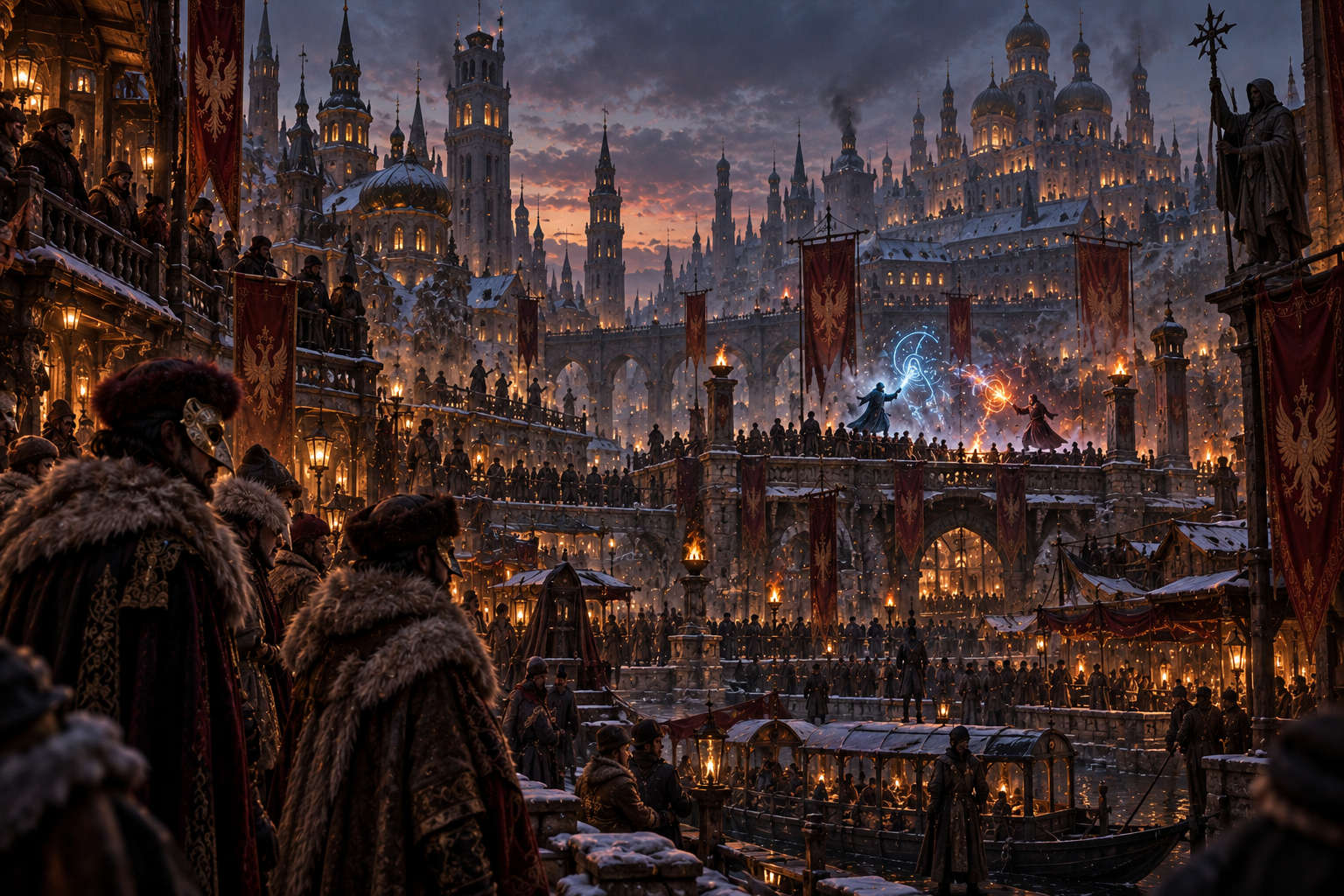
Karyosk is a country of western Halcyr, occupying the steppe that forms the landmass's western shore. East of it is Ardalia. West of it is water. It is a recognized sovereign state whose constitution is a pact of houses and cities rather than a theocratic federation. Power is plural, seasonal, and rarely where a foreign map places it. Drovennegrad is the principal urban centre and the customary seat of the High Table. Myrosk and Veltragh rank with it among the cities that foreign merchants actually mean when they say they are "going west."
Foreign accounts, especially Ardalian ones, describe Karyosk as a land of unregulated sorcery, aristocratic intrigue, and winter. The description is not a lie. It is a sermon. Karyoskian magical culture is famous for freecasting, sigil dueling, glyphwrought constructs, and a professionalization of espionage that the country itself treats as a craft with standards, jokes, and pensions. What it is not famous for, in Viremdane, is having a law. It has a great deal of law. The law is simply not Concordian. It is house-law, city-law, duel-law, and the contracted silence of the Masked Orders, stacked until a person of sense can navigate them and a person of sermons cannot.
In climate, manners, and historical memory, Karyosk is Halcyr's west: rye instead of wheat as the staple grain, long winters, river ice used as a road, bulbous palace-kilns, and a taste for intensity that Ardalian visitors experience as either glamour or a headache. Comparative geography has sometimes reached for eastern European analogues. The analogue is cultural. The compass bearing is not. Karyoskians reach for the river, the house, and the mask, and do not particularly care what the comparison is for.
Geography
Karyosk is a steppe country that keeps a river. The Crescent Steppe occupies the outer west: windy grassland, horse-camps, and the foundry-town of Myrosk. The River Skorna occupies the inner east, against Ardalia, and Drovennegrad stands on its braid. The Skorna does not run toward an eastern inland sea. It runs west through the steppe toward open water off the western shore. When it freezes, Karyosk becomes more connected, not less. Ice-roads carry sledges, house-companies, and rumours at a speed the autumn mud forbids. Summer restores the barges and the mosquitoes.
South of the steppe is ocean. The Graying Reaches are not the next country down. North of Karyosk is also water; Norskyla is northeast, across Ardalia's Tharnwatch rather than across a shared forest frontier. Concord inspectors historically arrived late because the Crescent road is short, cold, and already out of their jurisdiction the moment they leave the last Ardalian shrine.
A western knot of the Sundering Leychain underlies the Skorna at Drovennegrad. Myrosk occupies a secondary knot on the steppe, famous for mineral waters, foundry-heat, and a local Weave that glyphwrights describe as "willing to take a stamp." Veltragh sits in the same Skorna country as Drovennegrad, a diplomatic knot at the Ardalian contact: not the strongest node, but the one at which workings of landmass-scale ambition have twice been attempted and once catastrophically completed in the negative. Flamewar fallout still turns up as odd weather, odd fish, and the occasional field that will not take a sigil.
Government
Karyosk is a country in the way a winter river is a road: it works, it is used by everyone, and it will drown the person who insists it is a meadow. The High Table of Houses, seated customarily at Drovennegrad, is the nearest thing to a court of the realm. Great houses, chartered cities, and the glyphwright guilds send voices. Decisions require a majority that can survive the journey home. The Table elects, at seven-year intervals, a Prince-Speaker who holds the foreign seals, commands in declared war, and is forbidden, by a custom no one admits to writing down, from being too interesting.
Beneath this thin crown, the real sovereignties are houses and cities. A house is a kin-corporation with lands, laboratories, retainers, a mask-right, and a memory of having been a kingdom. House Drazhen, House Volskara, House Chevryn, and House Yastrom are among those whose names a foreign merchant is expected to know before quoting a price. Cities hold charters that predate some of the houses and will, they imply, outlast them. Drovennegrad's charter is a document of such baroque compromise that law students copy it for stamina. Myrosk's is shorter and smells of foundry-charter. Veltragh's includes the humiliating and indispensable clauses of the Treaty of 2E 806.
Law is personal, territorial, and theatrical. A dispute between equals of a certain rank may be taken to a recognized dueling circle rather than to a bench. Sigil duels are workings with rules, seconds, and a public notary of the Weave; they are not brawls, though brawls also occur. Espionage is not a scandal. It is a profession with guild-shades, and a house that cannot keep a competent listener in another house's kitchen is considered poorly dressed.
The Dominion's claim to landmass-wide style is treated in Karyosk as a category error. Ardalian licences have no force west of the last agreed shrine on the Crescent road. Karyoskian house-seals have no force in a Viremdane parish, which does not prevent them from being used there anyway, at night.
History
Western Halcyr in the Stone-Scribed Period was a country of river forts, horse-camps, and ancestor-pacts that had not yet decided whether they were cities or kin. Marks cut into bone and bronze from this era already show the characteristic Karyoskian double move: a public face and a contracted interior. Divine-ancestor cults here tended to be less parish-shaped than bargain-shaped. One did not worship so much as close a deal, and then keep it, or be kept by it.
The Twilight Concord arrived as a crate of books, a theory of inspection, and a tone. Karyosk took the books. Collegia of a sort already existed on the Skorna; they became laboratories. The theory of inspection was translated into house-seals, guild-stamps, and the dueling notary. The tone was declined. Unification of the Dominion in 2E 713 was watched from the west with the interest one gives a neighbour's wedding: sincere congratulations, gifts that were also messages, and no intention of moving into the house.
The great Karyoskian bid is remembered as the Working at Veltragh. In the early ninth century of the Second Era, a coalition of houses attempted to bind the western Leychain nodes into a single instrument, an engine that would have made Drovennegrad, not Viremdane, the place from which the Weave was addressed. The working failed in public. Accounts differ as to whether it failed because the Weave refused, because a rival house sabotaged the key, or because the Masked Orders collected a debt that had been left too long on the books. The blast-shadow is still pointed out to visitors who want a moral.
The Treaty of Veltragh in 2E 806 was the diplomatic sediment of that failure. It forbade landmass-scale unbound workings, recognized freecasting as the law of Karyosk, recognized Concordian licensing as the law of Ardalia, and installed at Veltragh a joint watching-house that both sides staff with people they do not quite trust. Ardalian schoolbooks call the treaty the moment Karyosk was prevented from setting the world on fire. Karyoskian schoolbooks call it the moment the east admitted it could not examine the west. Both are teaching a victory.
The Flamewar of the Skarn Vales drew house-companies northeast onto the Tharnspire seam and returned them thinned, decorated, and argumentative. Glyphwrought engines saw their first Halcyrite war. So did the habit, never since lost, of hiring Norskylic rune-contingents and then complaining about their invoices. Postwar Karyosk doubled down on private laboratories and on the doctrine that a country which has failed to seize the Leychain must at least be too complicated to be seized itself.
Magic
Karyoskian magic is a workshop culture. Freecasting does not mean the absence of rules. It means that the rules are those of a craft, a house, and a reputation, not those of a Bureau. A caster is responsible to a patron, a guild, a dueling second, and the people who will have to live beside the result. Paper exists. It is a contract, not a licence, and it is often shorter than the working it describes.
Sigil dueling is the public art. Two practitioners, a circle, a notary, and a question that the law would take a winter to answer are reduced to a contest of diagrams, timing, and nerve. Deaths occur. So do careers, marriages, and the settling of grain-rights. A duelist whose sigils are merely pretty is a poet. A duelist whose sigils close is a citizen.
Glyphwrought constructs are the country's other export and its domestic furniture. Myrosk's foundries bind sigils into ceramic, bronze, and a local glass that holds heat the way Ardalian lumen-glass holds day. The famous bulb-kilns of Drovennegrad palace-quarters are heating-workings as much as architecture: stacked, glazed, faintly singing in deep winter. Automaton labour exists in the foundries and the ice-road relays. It is legally a tool, culturally a servant, and theologically a problem the Masked Orders have not finished taxing. Unsound automata—the ones that walk home with the wrong gait—are the stock horror of Karyoskian popular theatre and, periodically, of Karyoskian streets.
Espionage-magic is a recognized specialty: listening-wards, mask-glamours, inks that wait, birds that are not birds. Concord sermons treat this as the national vice. Karyoskian guild-shades treat it as the national literacy. A person who cannot tell when they are being watched is, in steppe slang, still dressed for the east.
Religion
The Masked Orders are the prevailing religious fact of Karyosk, though "religion" is an eastern word that fits them like a borrowed coat. They are a lattice of lodges, saint-contracts, and ritual veiling whose public doctrine is that a person is a set of faces, and that the serious work of a life is knowing which face to show to which power. Saints, in this economy, may have been living people, dead people, or contracted patterns in the Weave that have acquired names by being paid.
A saint-contract is a legally recognizable pact. It may bind a house to a working, a city to a winter, or a person to a silence. Breach is not a sin in the Luminarchate sense. It is a default, and defaults are collected. The Mask of Seven Mouths, a famous and possibly legendary contract-object, is invoked in popular speech the way other countries invoke a devil: as the deal one should not have needed to make.
Veiling is everyday theology. In many Skorna-side contexts, a person of a certain rank appears in public under a painted mask proper to house, city, season, or task. To show the living face is intimacy, insult, or a declaration that one is off the board. Foreigners who refuse a courtesy-mask at a High Table reception are remembered. Foreigners who put one on upside-down are remembered longer.
Luminarchate missions exist in Drovennegrad and Veltragh, tolerated as a minority with good paper. Hearthfire hearths exist among northern-born retainers and ice-road people. Neither has displaced the Orders, because neither has offered a better theory of why a bargain should be kept when keeping it is expensive.
Culture
Karyoskian culture is intense, layered, and fond of interiors. Street-fronts in Drovennegrad can look almost plain, even shabby, until a door opens on tile, heat, mosaic, and a table that has been arguing since autumn. Hospitality is a performance with rules. A guest is fed, warmed, and not asked the real question until the second pot of tea, or the third, depending on the house. The tea itself is a glyphwright's joke: kettles that do not go off the boil, samovar-cousins that have been singing in the same corner for a century.
Staple food is rye, beet, cabbage, river sturgeon, and the fat of whatever the ice-road brought. Skornya, a strong rye spirit, is both a drink and a unit of sincerity. Steppe stations add fermented mare's milk and a courtesy toward horses that city people parody and privately envy. Festival cooking is a siege of dumplings, pickled everything, and sweets that look like jewellery and taste like a dare. Ardalian wine is imported as a status liquid and mixed, to Viremdane's horror, with things that have opinions.
Dress is fur, wool, glazed-tile colour, and the mask. House colours are a heraldry that children learn before they learn the rivers. A winter coat in Drovennegrad is a piece of architecture. A summer shirt in Myrosk is a foundry concession. Theatre, the other national art, runs from mask-liturgy to scabrous ice-road farce, often on the same bill. Alchemical mosaics that shift under a lie are a palace toy and a court-reporter's dream.
The national vice, if one must be named in Concordian terms, is not cruelty. It is the refusal to be simple. A Karyoskian explanation of a political event will include at least one house, one saint, one laboratory, and one person who was pretending to be someone else. Sometimes this is accurate.
Cities
Drovennegrad is the principal city: a braid of the Skorna, a Leychain node, a palace-quarter of bulb-kilns, and a charter that has outlasted several theories of the state. It stands on the inner steppe, against Ardalia, close enough to Viremdane for spies and not close enough for stamps. It is not beautiful in the Viremdane sense. It is compelling. River-fog, ice-road traffic, mask-shops, and the High Table's closed windows give it the air of a place that is always in the middle of a sentence. Foreign merchants who say they are "going to Karyosk" usually mean they are going here, and that they have hired someone to tell them which face to wear.
Myrosk is the foundry-city of the Crescent Steppe, built where mineral springs, a secondary Leychain knot, and an unreasonable supply of stubborn people coincide. Glyphwrought industry is its speech. The city smells of hot ceramic, wind, and the particular ozone of a sigil closing in metal. It supplies automata, kiln-work, weapons, and the technicians who keep Drovennegrad's palaces from freezing in a theoretically interesting way.
Veltragh is the treaty-town of the same Skorna country as Drovennegrad, smaller, handsomer, and unable to forget that the west once tried to pick up Halcyr here and dropped it. The joint watching-house, the blast-shadow, and a thriving trade in diplomatic hospitality make it the place where Ardalian and Karyoskian officials practice not understanding one another in comfortable chairs. It is also, not coincidentally, a city of spies so dense that the guild-shades have been known to spy on their own members for lack of foreign inventory.