Halcyr
Overview
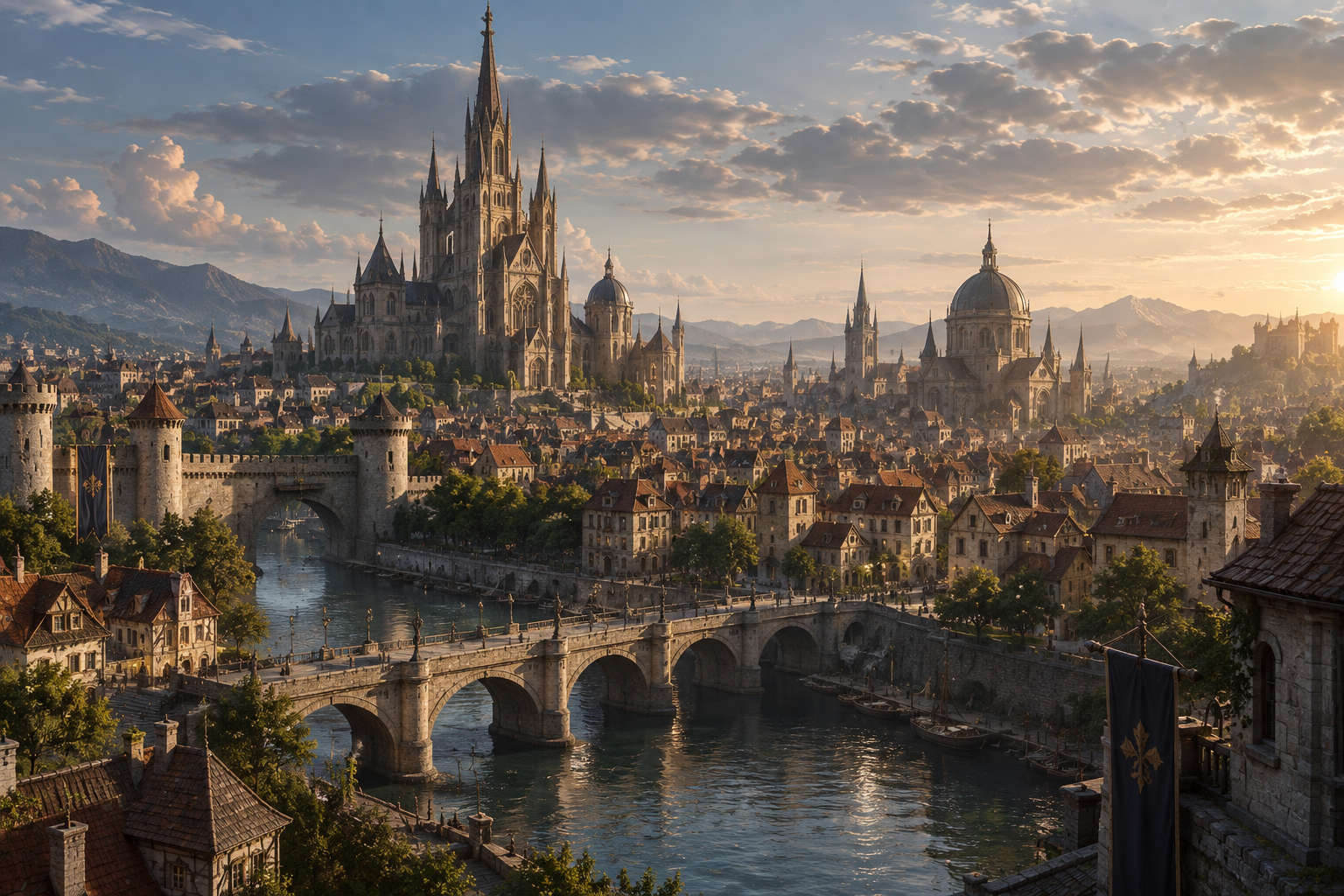
Halcyr is a compact landmass in the far northwest of Oorde, lying against the northern ice. Its inhabited ground is small enough to walk in the mind as a single shape: highland Norskyla to the north, temperate Ardalia in the centre with a short eastern lobe, and steppe Karyosk along the western shore. It is the home of several of the planet's most densely documented human civilizations and is widely treated, in Halcyrite scholarship itself, as the seat of classical magical theory and of the earliest surviving attempts to bind spellcraft to law.
Those three regions are the whole of settled Halcyr. They do not front a southern desert. Immediately south of Ardalia the land ends in pelagic sea, occupied by Draugormyr rather than by Halcyrite towns. East of Ardalia's lobe the water opens again. North of Norskyla the ground is ice. West of Karyosk there is no further Halcyrite country on the map: the steppe is the western edge.
Later comparative geography has often likened Halcyr's cultural texture to that of medieval and early modern Europe: a literate mosaic of related languages, a highland north, a temperate centre, and a steppe west, all close enough to quarrel. The comparison is a foreign convenience. On Oorde, the landmass's distinctiveness is magical as much as climatic. A fractured leyline known as the Sundering Leychain crosses all three principal regions, and the density of ambient mana along its nodes has shaped where cities rose, which wars could be fought, and which institutions claimed the right to say who may touch the Weave.
Name
The name Halcyr is the conventional international form. Folk etymologies inside Ardalia gloss it as "high circle" or "the ring of halls," referring either to the early confederations of river towns or to the geometric figure used in Concordian diagrams of licensed spellcraft. Linguists treat both derivations as after-the-fact. Cognates in Norskylic and older Karyoskian dialects point more plausibly to a root meaning "the land inside the winter sea," though the reconstruction remains disputed.
Political usage is sharper than etymology. The official style of the Ardalian state is the Halcyr Dominion, a name that presents Ardalia as the landmass's legitimate centre. Karyoskian houses and Norskylic thanes accept Halcyr as a geographical term and reject it as a claim of sovereignty. Diplomatic protocols therefore distinguish carefully between "Halcyr" the landmass and "the Dominion" the Ardalian polity.
Geography
Halcyr is topographically varied for its size, not because it spans a hemisphere. Norskyla occupies the iceward highland north. Ardalia occupies the temperate middle, including an eastward bulge of the same climate. Karyosk occupies the western steppe, along the same latitude as Ardalia's heart. Around that cross the neighbouring ground is water, except due north, which is ice.
Older Ardalian school-maps still draw a "Valebright Sea" as if it were a western basin of bright harbours. The land does not support a western sea: west of Ardalia is Karyosk. Ardalian shipping, such as it is, faces the open water east of the temperate lobe and the pelagic water due south. The north-facing waters around Norskyla are ice-margin, fog, and the sort of blankness older human charts used for seas they did not farm. Later contact with abyssal and pelagic societies complicated that blankness without moving the ice.
Natural barriers here are short because the countries are adjacent. The Tharnspire is best read as the highland-temperate contact between Norskyla and Ardalia, a rune-watched seam rather than a continental wall. The Ashen Teeth, if they are to be named, belong on Norskyla's seaward flanks, not as a separate occupied country. The Crescent Steppe is not an eastern frontier. It is Karyosk: the western steppe that has historically limited the easy movement of Concord inspectors, grain armies, and parish clergy toward the setting sun. The result is a landmass that shares a deep prehistoric substrate and a handful of pan-Halcyrite crises, yet speaks, prays, and licenses magic in persistently different keys.
The Sundering Leychain
Mana density is high across Halcyr, but it is not uniform. The Sundering Leychain is a fracture in the Weave that crosses Ardalia, Karyosk, and Norskyla on a short, irregular line scaled to the landmass rather than to a hemisphere. Cities of the first rank sit on its nodes with a regularity that later geomancers treat as almost diagnostic: Viremdane on the central temperate node, Drovennegrad where the western chain meets the steppe, Thryngardheim where a northern spur dives under highland and ice-margin water. Lesser towns cluster on secondary knots. Rural districts in the "quiet intervals" between nodes are not magically barren, but they produce fewer prodigies, fewer licensed collegia, and fewer catastrophes.
The Leychain is also a military geography. Whoever holds a node can, in principle, draw on a deeper well of ambient mana than a rival working from ordinary countryside. The Flamewar of the Skarn Vales was fought for that reason. So, in a quieter register, was the entire Ardalian project of licensing: Concordian theory treats the Leychain as a public hazard that must be administered, not as a private mine.
Surrounding waters
South of Ardalia's last temperate ground the land gives way to pelagic sea, not salt-sink desert. Halcyrite chronicles that still speak of "the Graying Reaches" as a southern province of Halcyr are describing a desert that exists much farther south, across water already claimed by Draugormyr. Missionary columns that set out due south from Ardalia do not find dunes. They find ocean, and, if they keep going, other people's trenches.
The equatorial deserts and savannas of Dhakumbe, Hun Rakhemen, and the Thousand Tribes are therefore not a Halcyrite hinterland. They are foreign landmasses. Concord surveyors who mapped "southern Halcyr" onto those deserts were measuring ambition, not adjacency.
Regions
Modern Halcyrite geography recognizes three principal inhabited regions. Only Ardalia and Karyosk are countries in the ordinary sense. Norskyla is a cultural and geographical region whose highest common institution is an assembly, not a crown. There is no fourth, desert region on this landmass.
Ardalia
Ardalia occupies the central temperate heartland and the short eastern lobe of the same climate. It is the seat of the Halcyr Dominion, a federated theocratic bureaucracy whose capital at Viremdane concentrates the Senatirum, the Concord Bureau, and the principal collegia of licensed magic. In international letters, Ardalia is frequently the default Halcyrite reference society. Foreign accounts that speak of "Halcyrite law," "Halcyrite magic," or "a Halcyrite city" are more often describing Ardalian institutions than the landmass as a whole. Its western neighbour is Karyosk, not a sea.
Karyosk
Karyosk occupies western Halcyr's steppe. It is a recognized country whose internal life is a contest of houses, cities, and laboratories rather than a parish-and-collegium hierarchy. Drovennegrad is its principal urban centre; Myrosk and Veltragh rank with it among the cities that foreign merchants actually mean when they say they are "going west." Karyoskian magical culture is famous for freecasting, sigil dueling, glyphwrought constructs, and a professionalization of espionage that Ardalian moralists prefer to call a national vice and Karyoskians a national craft.
Norskyla
Norskyla occupies the highland north, between Ardalia and the ice. It is organized around clans, thanedoms, oral law, and the High-Thing, not around a capital bureaucracy. Thryngardheim, Nymmroot Vale, and Vetturfjall are among the names that appear in both saga and later gazetteer; they sit in those highlands rather than claiming countries of their own. Norskylic magic is ancestral and resonant. Echo-runes, spirit-binding, and the sealing of landscape are treated as continuations of law and kinship, not as a profession one takes up after an examination.
History
Halcyrite deep history is conventionally divided into a long First Era of local cultures and a Second Era dated from the Twilight Concord, the Ardalian settlement that first made licensed magic an export. The numbering is itself an Ardalian convenience. Norskylic thanes count by High-Things and winter-marks. Karyoskian houses count by princely lists. All three calendars can be reconciled, with patience, and the reconciling is a small scholarly industry in Viremdane.
The later First Era is remembered as the Stone-Scribed Period: river towns and highland halls cutting marks into bone, timber, and living rock; divine-ancestor cults; primitive runic experiment; and a magical practice that was local, dangerous, and only intermittently distinguishable from worship. Toward the end of that period, Norskylic workings sealed the Ninefold Gate, a rift in the Weave on the iceward northwest whose leaking had already begun to disorder weather, dreams, and the behaviour of animals along the highland coast. The Sealing is the first Halcyrite event that later historians agree was landmass-wide in consequence, even if its authors did not think in those terms.
The Twilight Concord opened the Second Era. After a sequence of river-wars, parish burnings, and unlicensed workings that killed harvests as readily as armies, Ardalian magi, Luminarchate prelates, and the greater feudal houses bound themselves to a common rule: spellcraft would be taught, licensed, inspected, and punished as a public craft, not kept as a household mystery. Feudal contracts, ceremonial governance, and the first Concord registers spread outward from the Vire with missionaries, clerks, and marriage. They did not spread evenly. Karyosk took the books and not the inspectors. Norskyla took the warning and not the licence.
The Unification of the Dominion, conventionally dated to 2E 713, federated the Ardalian duchies, city leagues, and collegia under Viremdane. It did not unify Halcyr. It did give the landmass a state large enough to speak as if it had.
The Treaty of Veltragh followed a western bid for magical supremacy. Karyoskian houses attempted, at Veltragh, to raise a working that would have made the western Leychain nodes a single instrument. The working failed. The treaty that followed, in 2E 806, froze a legal geography that still holds in outline: Concordian licensing as the law of Ardalia, freecasting as the law of Karyosk, and a prohibition on landmass-scale unbound workings that both sides accuse the other of probing.
The Flamewar of the Skarn Vales (2E 941–948) was the landmass's most destructive magical conflict, fought along the highland-temperate seam where Leychain spurs run close to the surface. Fire-workings, counter-seals, and starved weather left districts of fused ground that still glow on some nights. The war involved Dominion banners, Karyoskian house-companies, and Norskylic rune-contingents hired, or self-invited, on both sides. Its settlements redrew nothing as cleanly as the maps claim. Its memory remains a standard argument for licensing in Ardalia, for private strength in Karyosk, and for not lending the ancestors' marks to southern quarrels in Norskyla.
Magic
Halcyr is not one magical culture. It is three neighbouring answers to the same dense Weave. The pelagic sea to the south is a fourth magical world, but it is not a Halcyrite one.
Concordian Spellcraft, the Ardalian tradition, is codified, licensed, and legally bound. A working is a named procedure with a registered diagram, a qualified caster, and a paper trail. The Senatirum and the Concord Bureau exist to keep that trail complete. The tradition's virtues are reproducibility, public accountability, and a genuine reduction in village catastrophes. Its vices, according to every Karyoskian pamphlet ever smuggled east, are timidity, clerical capture, and the pretence that the Weave cares about a stamp.
Sigil dueling and freecasting, the Karyoskian tradition, treat innovation as a house asset and a personal honour. Glyphwrought constructs, competitive laboratories, and legally recognized duels occupy the space that Ardalia fills with examinations. The tradition's virtues are speed, variety, and a craftsman's intimacy with materials. Its vices, according to every Concord sermon ever preached west, are corpses, hauntings, and the sale of unsound automata to people who cannot read a sigil.
Echo-runes and spirit-binding, the Norskylic tradition, are ancestral, oral, and resonant. A working is less invented than recovered: a pattern already present in saga, kin, stone, or the echo of a previous voice. Runes are carved into tools, keels, door-trees, and the land itself. The tradition's virtues are durability and a refusal to separate magic from obligation. Its vices, from a southern clerk's chair, are unintelligibility, unlicensed landscape, and the habit of answering a census with a story.
What the three share is the Leychain, a high background of ambient mana, and a memory that magic is not an ornament. It is how harvests fail, how gates open, and how states justify themselves.
Culture
Halcyrite high culture is a family quarrel conducted in related arts. Ardalia illuminates manuscripts, glazes river-stone, and paints arcane frescoes in collegium halls whose perspective lines are also spell-guides. Karyosk sets alchemical mosaics into palace floors that change colour when a lie is spoken over them, and it has made the painted mask a public face rather than a carnival prop. Norskyla carves saga into bone, antler, and standing stones that are both literature and legal record. A travelling eye can see, in all three, a love of dense surface, of work that can be read twice: once as ornament, once as instruction.
Everyday culture diverges more sharply than the arts. Ardalian life is parish-timed, table-formal, and verbose on paper. Karyoskian life is house-timed, winter-long, and careful about who sees whose face. Norskylic life is season-timed, guest-lawed, and suspicious of any claim that a thing written in a southern book outranks a thing spoken by an elder in a hall. Food, dress, and humour follow the same splits: wine and wheat in the centre, rye and steppe-fat in the west, fish, barley, and hearth-smoke in the north.
There is, nevertheless, a pan-Halcyrite type in foreign caricature: a person who argues about magic as if it were weather, keeps more than one calendar in the head, and assumes that "the world" means, first of all, this landmass. The caricature is unfair to everyone who has ever shipped south into pelagic water or north onto the ice. It is not wholly invented.
Religion
No single religion dominates Halcyr. Three major belief systems prevail, each entangled with a magical tradition and a style of government.
The Luminarchate, centred in Ardalia, worships divine law and luminal order: light as the visible form of a rule that the world is supposed to keep. Its parish towers, solstice examinations, and theology of licensed gift have given the Dominion much of its moral language.
The Masked Orders of Karyosk are less a church than a lattice of secretive pacts, saint-contracts, and ritual veiling. Public piety is a matter of which face one shows; the serious work happens in contracted silence with named powers that may or may not have been living people once.
The Hearthfire Faith of Norskyla treats the hearth as the world's navel, saga as scripture, and oath as the only theology that has to work in a storm. Ancestors are not metaphors. They are parties to the household, and a fire allowed to die is a legal event as well as a practical one.
Older Stone-Scribed cults survive in pockets, especially along the Tharnspire seam. Concordian classification files them as "unlicensed worship." The people who keep them file Concordian classification as a southern opinion.