Norskyla
Overview
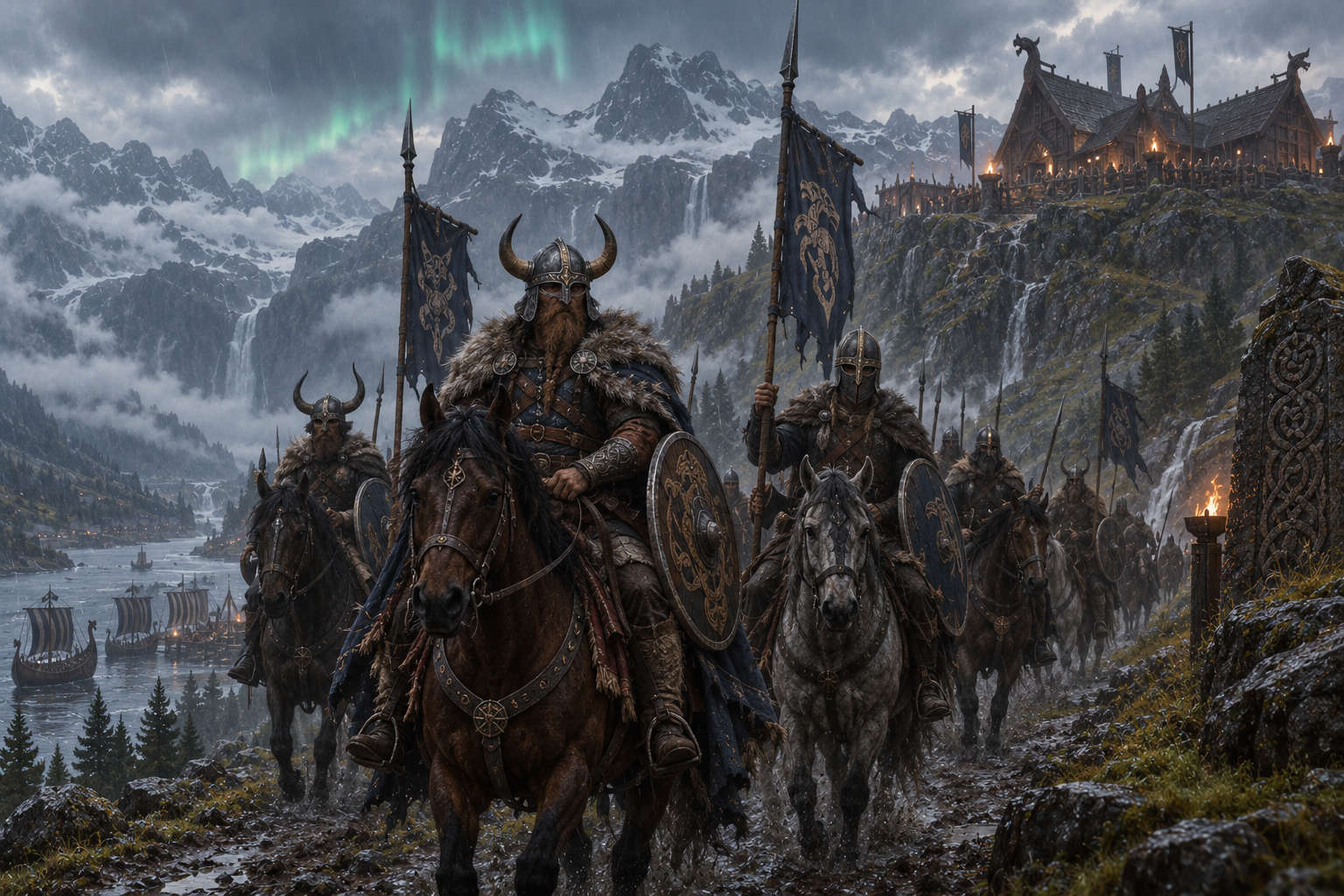
Norskyla is the northern region of Halcyr, highland country between the ice and Ardalia. It is not a state in the Ardalian or Karyoskian sense. No single crown claims it with a straight face. Its public life is organized around clans, thanedoms, oral law, and the High-Thing, an assembly that can bind the north for a season or a generation and then dissolve back into weather, kinship, and the next argument about a keel.
To southern clerks, Norskyla is a margin: cold, oral, under-licensed, and picturesquely behind. The description says more about the clerks than about the north. Norskylic societies kept runes, guest-law, and spirit-bound objects through centuries in which Ardalia was still inventing the stamp and Karyosk was still inventing the laboratory. The Sealing of the Ninefold Gate, a rift-working of the later First Era on the ice immediately northwest of the highland, remains the largest cooperative magical act in Halcyrite memory. It was not performed by a Bureau. It was performed by people who thought of the Weave as a neighbour with a long memory, and of themselves as kin who would have to live with what they carved.
The region's analogue in foreign comparative talk is the long subarctic north of another world's Europe: fjord maritime cultures, clan halls, saga, wet wool, and a reputation for arriving by water when they have not been invited. Norskylic people do not need the analogue. They have the Ashen Teeth, the aurorae, and a legal theory in which a ship, a sword, and a hearth can be parties to a case.
Geography
Norskyla is folded into iceward highland and a southern seam. The iceward north holds the Ashen Teeth: volcanic fjords, basalt walls, and deep inlets chewing the ice-margin waters to east and west. Due north the ground is ice, not a farmed ocean. Settlement clings to the water that remains: maritime halls, fish-drying grounds, boat-houses that are also law-houses, and terraces of barley wherever a slope will take a plough and a rune. Vetturfjall, a named peak of those highlands, is treated as a weather-maker and a witness. People swear by it without climbing it, which the mountain appears to prefer.
The southern highlands are the Tharnspire seam, where highland meets Ardalian temperate ground. Thryngardheim is the nearest thing to a capital that the region will admit: a hall-town at a fjord-head where a northern spur of the Sundering Leychain dives under water and stone. It is famous for a High-Thing field, a winter market, and a harbour that can hold the north's pride in a bad week. Nymmroot Vale is a cleft of the same highland, famous for the plant that gives it its name, for echo-ink, and for a quiet that southerners find either holy or unnerving. Thanedoms are catchments of kinship, grazing, wreck-rights, and the particular runes that open particular valleys. They do not get countries of their own.
Climate is wet highland. Rain, sleet, and a snow that does not know when to stop are the ordinary year. Summer is a long dusk in which everything that can be dried, sailed, or argued is dried, sailed, or argued. Winter is the indoor season, the saga season, and the season in which a dead hearth is a legal emergency. Mana aurorae are more frequently observed here than in any other Halcyrite region, and they are not treated as scenery. A strong aurora is a weather warning, a liturgical prompt, and, on the worst nights, a reminder of what the Ninefold Gate used to leak.
The Tharnspire is the southern wall, a short mountain seam rather than a continental range. Passes exist. They are rune-watched, snowed, and closed by people who do not regard a Dominion road-gazette as a reason to open them. South of the last Norskylic summer pasture, Ardalian speech begins. The transition is a day's walk and a change of law. Karyosk is not a northern neighbour. It is west of Ardalia; reaching it from the Teeth means crossing someone else's river.
Political order
A thanedom is a country of a kind: a territory, a hall, a fleet or a mountain-road, a body of oral law, and a thane who can be replaced if the hall decides the ancestors have been embarrassed. Clans cut across thanedoms. A person may be born to a clan, married into a hall, and sworn to a keel, and all three relationships will have legal weight at the High-Thing. The resulting politics look chaotic from a Senatirum bench and look, from inside a hall, like the minimum complexity required to keep a wet country from killing itself.
The High-Thing is the region's highest common institution. It meets at Thryngardheim in some years and, in others, at a field or island specified by the previous assembly, a habit that prevents any one hall from becoming a capital by furniture. The Thing hears feud, wreck, marriage-abduction that was not, harbour-dues, rune-disputes, and the rare question of whether the north will speak with one voice to the south. Its judgements are spoken, witnessed, and remembered. Writing them down is permitted and not trusted. A judgement that cannot be recited by someone who was not there is considered poorly made.
There is no Concord Bureau. There is no Prince-Speaker. There are, at most, speakers for a season, war-leaders for a named purpose, and the embarrassing possibility of a person so respected that other thanes start behaving as if they had a king, after which someone recites a saga about the last time that happened. Relations with the Halcyr Dominion are a long file of recognitions, refusals, and carefully worded winter-truces. Ardalia would like a census, a licence-roll, and a southern definition of a border. Norskyla will discuss the border and has, on several occasions, discussed it with axes. Karyosk hires Norskylic rune-contingents, pays in silver and skornya, and writes complaints about invoices that the High-Thing finds very entertaining when read aloud.
History
Norskylic deep history is the Stone-Scribed Period without apology. While river towns to the south were cutting flood-marks, fjord people were cutting kin-marks, wreck-marks, and the first echo-runes into living rock. Divine-ancestor cults here were not a prelude to a church. They were the household. A hall that could not name its dead was not a hall. Primitive runic experiment and spirit-binding were the same activity: asking a pattern already in the world to stay and be useful, and promising to stay in return.
The Sealing of the Ninefold Gate is the event by which later ages date the north's arrival in Halcyrite history, though the north did not think it was arriving anywhere. In the later First Era, a rift in the Weave on the ice northwest of the Teeth—nine-fold in the sense that it opened in nine linked wounds—had begun to disorder tide, dream, fish-run, and the minds of animals and people along the highland coast. The Sealing was a cooperative working of thanedoms that did not otherwise cooperate: nine great runes, nine halls, nine named ancestors, and a cost that saga still will not itemize except as "the winter that did not end in several places." The Gate holds. Echoes remain. Aurorae are among them. So are the rune-sealed wildernesses, valleys that will not open except to a spoken lineage, which later southern surveyors have filed as "unmapped" and which are mapped very well if one knows whose grandchild to ask.
The Twilight Concord was noted. Licensed magic, as a theory, was compared to asking a stranger to countersign one's marriage. Some Norskylic travellers took Concord schooling and came home speaking in paragraphs. They were listened to, because listening is law, and then the hall went on carving. Unification of the Dominion in 2E 713 produced gifts, envoys, and a request for a roll of practitioners. The roll was returned with a saga about a man who counted fish instead of catching them. Diplomatic relations have been in that key ever since: courteous, armed, and conducted by people who can recite more than they can stamp.
Norskylic contingents fought in the Flamewar of the Skarn Vales on more than one side, which the High-Thing still regards as a complicated but not unprecedented application of guest-law and invoice-law. The war's glassed ground is the Tharnspire seam itself, not a southern desert. The Treaty of Veltragh is respected as a southern document about southern problems. The prohibition on landmass-scale unbound workings is, from a Norskylic point of view, a belated compliment to a Gate that was already sealed.
Magic
Norskylic magic is not a profession one takes up after an examination. It is a continuation of kinship, craft, and landscape. Echo-runes are the characteristic form. A working is recovered rather than invented: a pattern already present in saga, in a grandmother's voice, in the grain of a keel, or in the stone of a particular valley. To carve an echo-rune is to ask that pattern to sound again. The caster's skill is in the listening, the carving, the offering, and the refusal to improve a thing that is already the right shape. Southern theorists call this conservative. Norskylic practitioners call this accurate.
Spirit-binding is the other half of the same habit. Anima-patterns—of ancestors, of animals, of a ship's luck, of a hearth-fire that has been kept for longer than a family can count—may be anchored in objects, places, and obligations. A sword can be a witness. A keel can be a legal person. A hearth can be a shrine, a court, and a stomach. The Hearthfire Faith and the magical tradition are not two subjects. A fire allowed to die is a working reversed without permission.
Rune-sealed wilderness is landscape magic as law. Certain valleys, screes, and inner fjords will not admit a stranger whose lineage has not been spoken at the right stone. This is not invisibility in the theatrical sense. It is refusal. Parties that enter anyway get lost, get weather, or get the kind of accident that sagas treat as a verdict. Concord surveyors have attempted licensed mappings. The maps come back elegant and wrong.
Nymmroot, a plant of the inner vale, is the north's most characteristic magical material. Its sap and ash take echo. Inks, stains, and the dark lines in bone-carving that southern collectors mistake for decoration are often nymmroot and a spoken name. Export is limited, not by Bureau writ, but by the Vale's own sense of how much of itself it is willing to have walking around in other people's pockets.
The north does not, as a rule, distinguish "technology" from "magic." A rivet, a rune, and a well-made oath are three ways of making a thing stay. Tools and buildings that would be inspected as licensed workings in Viremdane are, here, simply well-made. Tools that fail are not unlicensed. They are badly kin-kept.
Religion
The Hearthfire Faith is the region's prevailing religion and its theory of the household. The hearth is the world's navel: the place at which the living, the dead, and the weather agree to share a roof. Saga is scripture, not in the sense that a closed canon exists, but in the sense that a story correctly told is a form of truth that can be cited in law. Primal oaths—named, witnessed, sometimes carved—are the theology that has to work in a storm. A person who keeps an oath is pious. A person who can recite why the oath was shaped that way is educated. A person who breaks one is not a heretic. They are a defendant.
Ancestors are parties. They are fed, named, argued with, and, in spirit-bound objects, asked to stay useful. This is not ancestor-worship as a southern ethnographer's category. It is family law with a longer census. Divine figures exist in the sagas—weather-minds, sea-minds, the particular stubbornness of Vetturfjall—but they are treated as powerful neighbours rather than as a parish's employer.
Auroral nights have liturgical weight. Some halls douse everything but the hearth and listen. Some launch boats. Some do both, which is how several famous drownings and several famous songs began. Luminarchate missions have planted a few towers in the more trafficked fjords. They keep their lumens; the halls keep their fires; guests are fed at both if they behave. Masked Order contracts are rarer, and regarded as a southern style of getting into trouble on purpose.
Culture
Norskylic culture is a wet-country culture: wool, tar, smoke, and the social technology of getting a hall through a winter without a killing that cannot be paid. Guest-law is the famous part. A guest is fed, dried, and not asked their business until the asking can be done without shame. Abuse of guest-law is one of the few crimes that will reliably unite thanedoms that agree on nothing else. Feud is the other famous part. It is not chaos. It is a slow, expensive, rule-bound redistribution of blood and silver that the High-Thing exists, in part, to interrupt.
Material life is maritime and upland at once. Long-keeled boats, round shields, conical helms, and heavy cloaks are not costume. They are what a person wears to cross a fjord in rain that has opinions. Halls are timber, turf, and carved door-trees; mountain halls add stone and a different quality of echo. Bone-carved saga stones stand where other countries would put a notice-board. A person who cannot read a stone can still be read to, and is expected to remember.
Cuisine is fish, barley, seal in the outer Teeth, cloudberry-cousins, hearth-bread, and a range of fermented things that Ardalian visitors describe as a dare and then, if they are honest, ask for again. Mead is ceremonial. Small beer is daily. Drying-racks and smokehouses are architecture. A feast at Thryngardheim during a High-Thing is a diplomatic instrument: the seating is a map, the toasts are minutes, and the person who leaves hungry has been told something.
Speech is valued for tightness. A good story is long; a good judgement is short; a good insult is either. Writing exists—runes on bone, timber, and the occasional southern paper—and is treated as a prompt for memory rather than a replacement for it. Children learn recitation the way Ardalian children learn stamps. The resulting population is, from a Concord clerk's point of view, under-documented. From a hall's point of view, it is over-equipped.
Skeldhaven, a harbour on the Ashen Teeth, is the port most foreign ships actually find. It sells fish, nymmroot in quantities the Vale will tolerate, and rumours of aurorae. It also sells the experience of being politely not-told where the sealed valleys are. Travellers who want the picturesque north often stop here and write books. Travellers who want the north go inland toward the Tharnspire and come back quieter.