Oorde
Overview
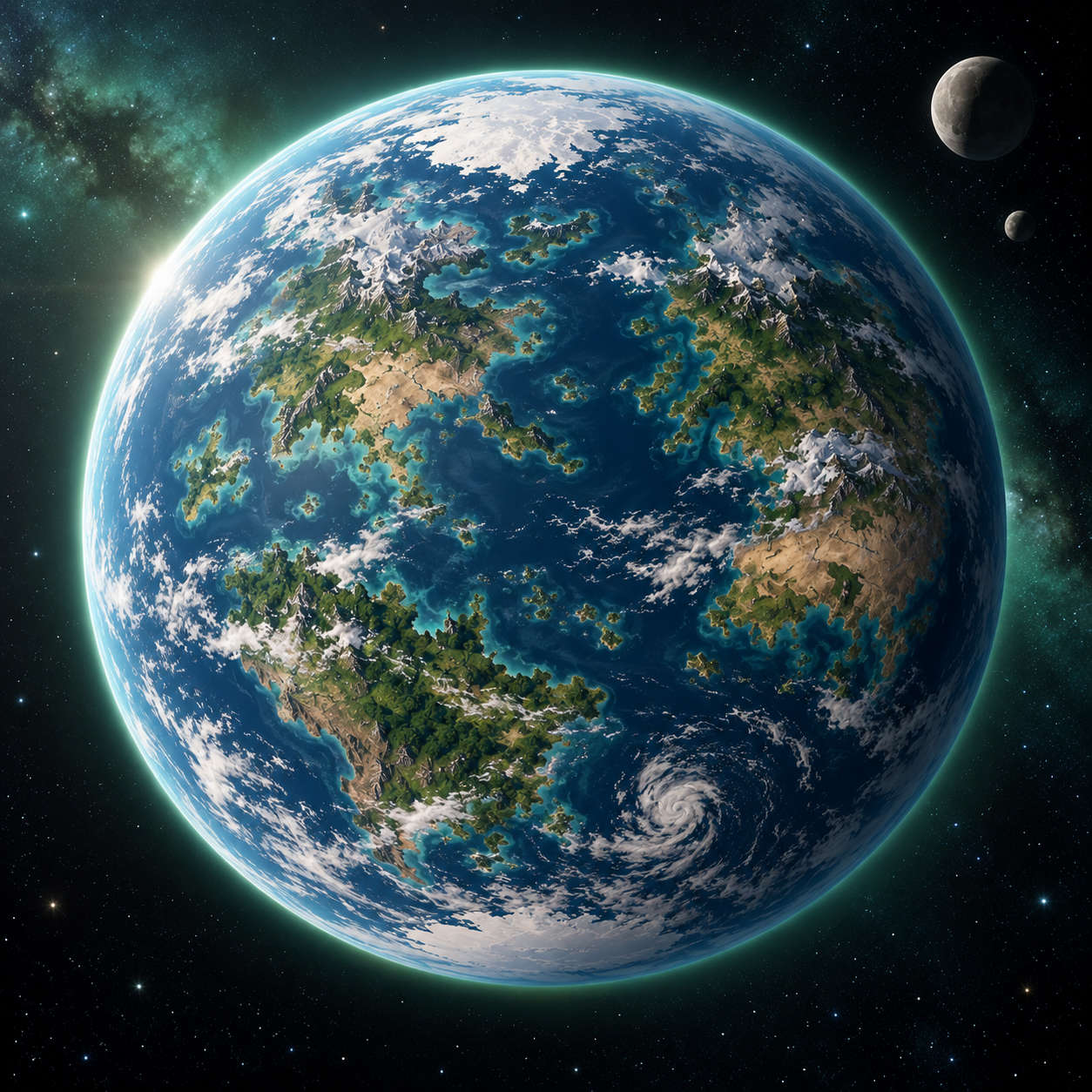
Oorde is a terrestrial planet and the principal inhabited world of the Oordean planetary system. It is notable for its extensive oceans, large continental landmasses, diverse sapient populations, and the natural presence of mana, a pervasive phenomenon associated with magic, life, and a number of otherwise anomalous physical processes. Oorde is the homeworld of humans, the marine Ormyr, and several other sapient or near-sapient peoples, as well as a highly diverse assemblage of magical and non-magical organisms.
Oorde is somewhat larger than Earth, although its surface gravity is sufficiently similar for broadly Earth-like terrestrial life to occur. Much of the planet is covered by ocean, including extensive abyssal regions inhabited by Ormyr civilizations. Its continents encompass climates ranging from equatorial rainforest and tropical savanna to temperate woodland, continental steppe, high-altitude desert, tundra and permanent polar ice.
Recorded human history on Oorde extends for several thousand years and includes the independent development of numerous urban civilizations. Among the best documented are the societies of Halcyr, including Ardalia, Karyosk, and Norskyla; the eastern sphere of Jinrya, dominated by Khaiten; and the Mesoamerican-influenced civilization of the Tahuacayal. These represent only a portion of Oorde's known cultural geography.
Unlike conventional astronomical bodies, Oorde possesses a naturally occurring mana environment. Mana interacts weakly with ordinary matter under most circumstances but can be manipulated by living organisms, producing phenomena collectively described as magic. Its presence has had substantial effects on the planet's biological evolution, human history, ecology and technological development.
Name
The name Oorde is the conventional international name for the planet in modern geographical and astronomical literature. Its ultimate etymology is uncertain. Several older languages possess cognates referring variously to "the inhabited world," "earth," "ground" or "that which lies beneath the sky," although it is disputed whether these words share a common origin.
Historically, most societies did not possess a distinct name for the planet as an astronomical object. Terms translated as world, earth, middle land and creation were more common. Oorde became increasingly standardized following the growth of long-distance navigation, comparative geography and astronomical scholarship.
Physical characteristics
Oorde is a rocky terrestrial planet composed principally of silicate rock surrounding a metallic core. Its internal structure is conventionally divided into the crust, mantle, outer core and inner core. Active plate tectonics have produced extensive mountain systems, volcanic arcs, continental rifts and ocean trenches.
The planet is larger in both diameter and surface area than Earth. Its comparatively large habitable surface has frequently been cited as one reason for the geographical isolation of many early civilizations and for the unusually high degree of biological and cultural regionalism found throughout recorded history.
Oorde nevertheless maintains surface gravity close enough to terrestrial norms to support large land animals and flying vertebrates. The existence of exceptionally large organisms, including several species collectively described as dragons, cannot be explained entirely by conventional biomechanics and is generally attributed in part to biological adaptations involving mana.
The planet possesses a substantial magnetic field generated by its metallic core. In addition to ordinary polar aurorae, Oorde experiences mana aurorae, luminous atmospheric phenomena caused by disturbances in the planetary mana environment. Unlike electromagnetic aurorae, mana aurorae may occasionally occur at lower latitudes or remain visible under atmospheric conditions in which conventional aurorae would be difficult to observe. They are particularly associated with northern Halcyr, including Norskyla.
Atmosphere and climate
Oorde has a nitrogen- and oxygen-dominated atmosphere capable of supporting terrestrial aerobic life. Atmospheric circulation is broadly comparable to that of Earth, although the planet's greater size, continental configuration and magical environment produce substantial regional variation.
Climate is governed primarily by latitude, elevation, ocean currents and continentality. Mana has comparatively little influence on ordinary day-to-day weather, but regions of unusually high mana concentration can develop persistent local anomalies. Documented examples include unusually stable fog banks, localized temperature inversions, altered precipitation patterns and storms associated with concentrated magical activity.
Such regions are sometimes called mana climates, although the term encompasses several unrelated phenomena rather than a single climatological process.
Oorde has extensive permanent ice at high latitudes. Seasonal snow cover extends considerably farther toward the equator across the northern continental interiors, while several equatorial regions support year-round tropical climates.
Geography
Oorde's surface is divided among several major continental masses, numerous smaller continents and islands, and a global interconnected ocean. Modern geographical convention recognizes a number of continents, though their precise boundaries differ between cultural and geological definitions.
Halcyr
Halcyr is a compact landmass in the far northwest, lying against the northern ice. Its inhabited ground is highland Norskyla, temperate Ardalia, and steppe Karyosk. Its cultures have frequently been compared with those of medieval and early modern Europe.
The central region of Ardalia contains the River Vire, temperate plains, and Viremdane, and has historically supported comparatively centralized states and highly institutionalized systems of magic.
Western Halcyr is Karyosk, a culturally distinct steppe country of competing houses, cities, and aristocratic laboratories. Karyoskian magical traditions are noted for experimentation and relatively permissive attitudes toward private spellcraft. Drovennegrad is its principal urban centre.
Northern Halcyr is Norskyla, highland fjords, thanedoms, and rune-bound upland between Ardalia and the ice. Norskylic societies possess strong traditions of rune magic, oral history, and clan-based government.
Jinrya
Jinrya is a compact landmass in the same northern band as Halcyr, east across open water. The name is first of all Khaitenese: an imperial ideology of ritual harmony, often pictured as a floral mandala with Khaiten at the core. It is also the ordinary geographical name for the land that claim covers. Halcyrite maps label the same ground "the Jade Mandala" or "the Harmonized East." Geological convention has not settled a separate continent-word for the rock.
Temperate Khaiten is the bureaucratic heart, with its capital at Tairen. Steppe Hmugdam occupies the northwest grass. Highland Dorgene occupies the iceward north, short of the ice itself. Jungle Lakh Dai occupies the southeast monsoon. Cenashir is a detached mountain island west of the main mass, across the Knifewaters: tributary to the Mandala Concord and culturally distinct even inside Jinrya, a place Tairen finds harder to read than its other petals. The four are vassals of Khaiten, variously sincere about the petal metaphor.
Tahuacayal lands
The Tahuacayal inhabit a major cultural region outside Halcyr whose environment includes tropical and subtropical highlands, forests, fertile volcanic basins and seasonally dry lowlands. Tahuacayal civilizations developed monumental cities, complex calendrical traditions and distinctive religious and magical institutions largely independently of Halcyrite civilization.
The term Tahuacayal is primarily ethnocultural rather than strictly geographical, and the wider landmass contains numerous peoples not traditionally classified as Tahuacayal.
Oceans
Oorde possesses several major ocean basins, many substantially larger than individual continental regions. The open oceans historically acted as significant barriers to human movement, contributing to the prolonged independent development of continental civilizations.
This interpretation is strongly anthropocentric, however. Oorde's oceans are themselves inhabited.
The deep sea contains extensive populations of Ormyr, a sapient marine species adapted to abyssal conditions. Ormyr settlements occur particularly around hydrothermal systems, geological ridges, brine pools and other productive deep-ocean environments. Consequently, regions historically depicted on human maps as uninhabited ocean may overlap with established Ormyr territories.
Recognition of this fact substantially changed modern conceptions of Oordean geography, particularly the traditional division between "inhabited land" and "empty sea."
Mana and the Weave
The most distinctive known natural property of Oorde is the presence of mana.
Mana is an ambient phenomenon distributed throughout the planet and its immediate environment. Its precise physical nature remains disputed. It is neither matter nor conventional electromagnetic radiation, although under particular conditions it can exchange energy with physical systems.
The total network of mana interactions is commonly called the Weave. The term originated in magical philosophy but is now also employed descriptively by scholars studying mana phenomena.
Living organisms appear unusually effective at interacting with the Weave. Sapient beings can deliberately alter mana configurations through learned or intuitive processes collectively known as spellcasting. Different cultures have consequently developed radically different theoretical descriptions of essentially related phenomena.
Magic does not generally create unrestricted energy or matter. Most magical processes involve the manipulation, transfer, transformation or temporary stabilization of existing matter, energy or mana. Complex practices may also interact with the anima, the persistent informational or metaphysical pattern associated with living beings.
One example is summoning, in which an anima pattern may be anchored while ambient mana is shaped into, or connected with, an appropriate physical vessel. Different traditions distinguish between constructed summons, contracted sapient entities and entities reached through planar or extradimensional connections.
Mana is not exclusive to sapient life. Numerous organisms have evolved biological structures capable of exploiting it. Consequently, the conventional distinction between a "magical creature" and an ordinary animal is partly artificial: magical ability is an evolved characteristic in many Oordean lineages.
Life
Oorde possesses a highly diverse biosphere whose underlying biochemistry is predominantly carbon-based and water-dependent.
Plants, fungi and animals occupy ecological roles broadly analogous to those found in terrestrial ecosystems, although many lineages have no direct Earth equivalent. Evolution has also repeatedly produced organisms capable of exploiting ambient mana.
Among Oorde's most conspicuous animals are dragons, a diverse group of large magical vertebrates. The largest species can attain dimensions comparable to large human-built vehicles and aircraft. Their characteristic breath weapons vary between species and may include fire, corrosive material, soporific effects and primarily magical emissions. In several species the apparent "breath" is not produced solely by the respiratory system but represents a spell-like projection anatomically channelled through the mouth.
Other magically adapted organisms range from relatively innocuous plants and insects to exceptionally dangerous predators and colonial species. The Gorewasp, for example, is a highly defensive social insect whose colonies are capable of posing a serious threat to large vertebrates.
The oceans support equally complex ecosystems, including numerous abyssal organisms adapted to extreme pressure, darkness and low food availability.
Sapient species
Humans are the most geographically widespread terrestrial sapient species known on Oorde and inhabit most climatic regions suitable for permanent settlement. Human societies vary enormously in language, religion, political organization and magical practice.
The Ormyr constitute one of the best-known non-human sapient species. They are large, eyeless marine organisms with elongated, many-limbed bodies and specialized facial appendages capable of fine manipulation. They navigate primarily through electroreception and other non-visual senses.
Ormyr societies occur throughout several deep-ocean regions. They construct settlements around productive geological formations and possess toolmaking, magic, oral or non-visual information traditions, and complex social organization. Ormyr civilization is culturally diverse; the use of Ormyr culture as though the species constituted a single civilization is considered obsolete in comparative anthropology.
The degree of sustained interaction between terrestrial and abyssal civilizations has varied greatly by period and region.
Human civilization
Human civilization arose independently or semi-independently in several parts of Oorde. Agriculture, urbanization, writing and organized magical practice consequently developed along multiple trajectories.
In Halcyr, the societies of Ardalia became particularly associated with the codification and institutional regulation of magic. Ardalian magical practice developed elaborate systems of education, licensing and legal accountability.
Societies in Karyosk developed a contrasting tradition emphasizing private experimentation, patronage and competitive magical innovation. The difference between Ardalian regulation and Karyoskian freecasting has been an enduring source of political and philosophical dispute.
Norskyla developed traditions centred on runes, oral law, ancestral memory and magic embedded in objects, places and obligations. Its relative geographical isolation contributed to the preservation of institutions considerably older than many southern Halcyrite states.
The Tahuacayal developed a separate complex of urban civilizations distinguished by monumental architecture, calendrical scholarship, ritual institutions and traditions concerning divine and draconic beings.
These civilizations represent only some of Oorde's human cultural regions. Historical references, trade goods and linguistic evidence indicate extensive networks of societies beyond those described in surviving Halcyrite and Tahuacayal sources.
Magic and technology
The presence of reliable magic has substantially altered technological development on Oorde, but has not eliminated conventional technology.
Mechanical devices remain preferable where they are cheaper, more predictable or require no trained caster. Magic is instead frequently incorporated into existing crafts, producing fields analogous to engineering, medicine, agriculture, metallurgy, transportation and communications.
The balance varies greatly between cultures. Ardalian institutions tend to formalize magical procedures and separate practitioners by qualification. Karyoskian workshops commonly integrate experimental spellcraft directly into artisanal production. Norskylic traditions often resist a distinction between "technology" and "magic," particularly where runes form permanent components of tools and buildings.
This uneven development means that Oorde cannot readily be assigned a single technological level. A rural settlement using animal traction and hand-forged tools may coexist with sophisticated magical infrastructure that would be impossible to reproduce through purely mechanical means.
Astronomy
Oorde has been recognized as spherical since antiquity by several independently developed scholarly traditions. The development of accurate astronomical instruments subsequently established it as one of several bodies orbiting its sun.
The night sky has played an important role in navigation, calendrical systems and magical theory. Several cultures independently observed correlations between astronomical cycles and variations in mana activity, although many traditional claims remain disputed.
Oorde's natural satellites have likewise accumulated extensive religious and magical associations. Their gravitational effects produce ocean tides, while some magical traditions claim that particular lunar configurations affect the Weave. Modern scholarship generally distinguishes measurable mana-cycle correlations from the considerably broader body of astrological tradition.
Exploration and cartography
For much of recorded history, maps of Oorde were regional rather than global. The size of the planet, dangerous ocean crossings, political fragmentation and the presence of hostile magical fauna made long-distance exploration difficult.
The development of improved navigation gradually connected previously isolated geographical traditions. This process demonstrated that many supposedly universal historical chronologies described only individual cultural regions.
Mapping the deep ocean presented a separate problem. Early human cartographers could measure coastlines and ocean depths but possessed little knowledge of abyssal political geography. Contact with Ormyr societies eventually demonstrated that several areas classified by humans as unexplored wilderness had been inhabited for centuries or millennia.
Modern Oordean cartography therefore distinguishes between physical, ecological, political and mana-geographical maps, each of which may portray the planet very differently.
Cultural significance
Ideas about Oorde's nature vary considerably between cultures. It has been interpreted as a created world, a living organism, a divine construction, one plane among many, and a purely natural astronomical body permeated by mana.
The discovery that mana itself can be investigated systematically did not eliminate these traditions. Instead, natural philosophy, theology and magical theory developed alongside one another, and disagreements concerning the ultimate origin of the Weave remain among the major unresolved questions of Oordean scholarship.
Despite the development of increasingly global geographical knowledge, the expression "the world" remains culturally ambiguous. To a Halcyrite scholar it may mean the planet; to an isolated community it may still mean the lands surrounding its own sea; and to an Ormyr living kilometres beneath the ocean surface, the familiar world may be one in which continents are merely the distant ceilings of an overwhelmingly aquatic planet.