Clothing
Overview
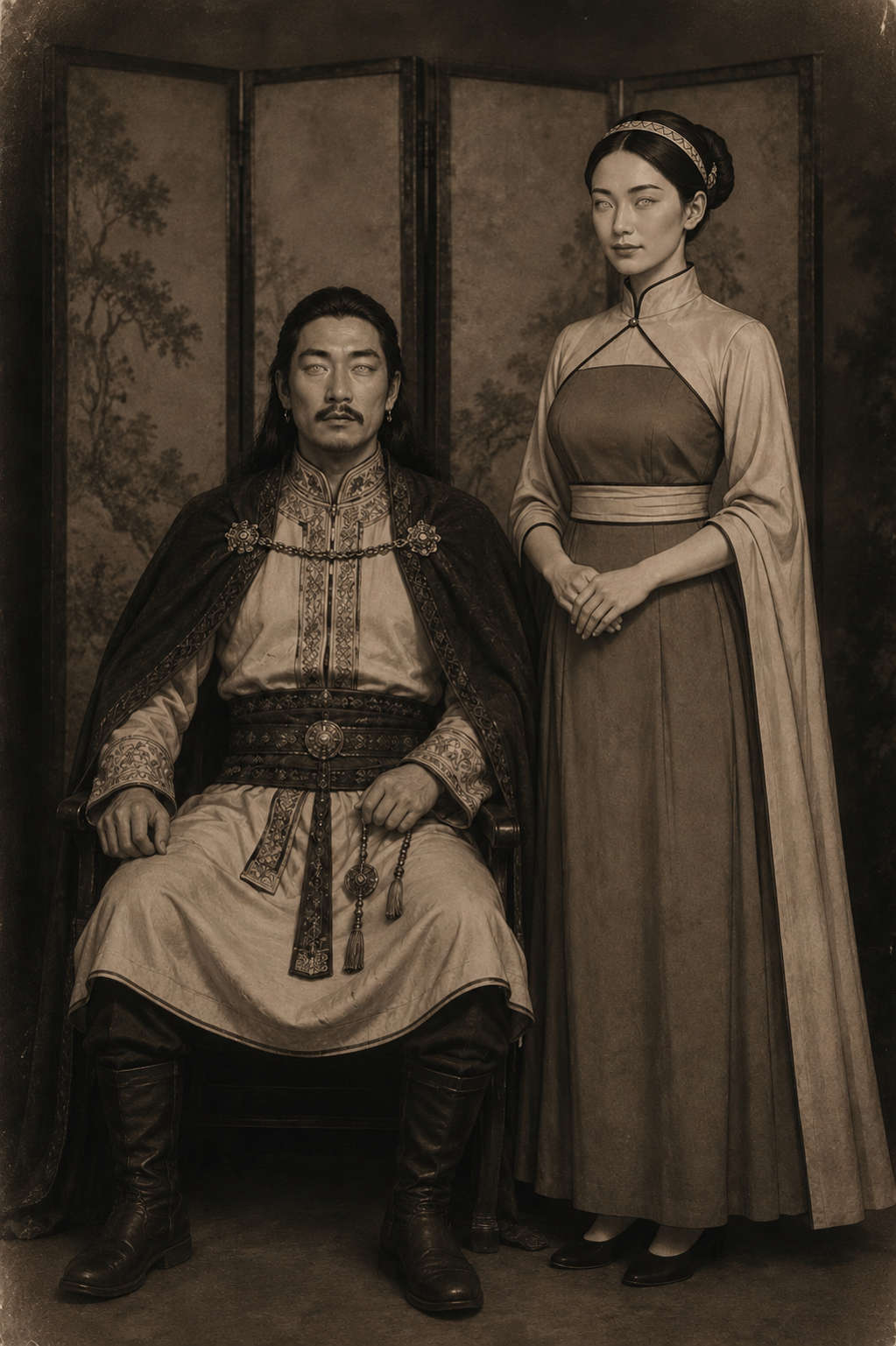
Canassarene clothing refers to the traditional and historical dress of Canassar and to later clothing derived from it. Styles vary among the five major cultural regions—Cënasa, Maruen, Vërunar, Armassin, and Hälvarinco—but they share a family of habits: garments cut and sewn into defined forms, openings that meet along the centre of the torso, layered inner and outer materials, functional belts and outerwear, and ornament concentrated at collars, hems, belts, and fasteners rather than spread across the whole surface.
Dress developed from prehistoric tunics of bast fibre worn under hide and fur, and was later transformed by weaving, tailoring, metalworking, and maritime trade. Among its most characteristic later materials is ayun cloth, a fine textile from the bast fibres of the highland fisca plant. Imported silk was valued as well, usually as a contrasting luxury rather than as a replacement for ayun.
Canassarene clothing is a related set of regional traditions, not a single national costume. Climate, occupation, and political history sharpened the differences: the structured court dress of Cënasa, the highland and pastoral clothing of Maruen, the maritime dress of Vërunar, the cold-weather layering of Armassin, and the long-robe tradition of Hälvarinco.
Related articles: prehistoric dress; traditional clothing.
Reference
Clothing is treated in the following articles:
- Prehistoric dress: bast-cloth tunics, hide outerwear, toggle-and-loop closures, and the common ancestry of later regional styles.
- Traditional clothing: the five regional traditions and the contrast of masculine and feminine silhouettes.
Construction and silhouette
A recurring feature of Canassarene dress is the preference for constructed garments. Sleeves, bodices, skirts, trousers, and outer pieces are cut and sewn into defined forms rather than relying mainly on wrapping a large length of cloth around the body. Reconstructions of early dress show stitched bast-cloth tunics beneath sleeveless deer-hide garments, and that logic of a sewn inner layer plus a protective outer layer remained the usual architecture.
Another persistent feature is the centre-front opening. Early garments were secured with antler, bone, or wooden toggles passed through fibre loops, so the two sides met along the centre of the torso without a deep left-over-right or right-over-left wrap. Later toggles became smaller and more elaborate—carved wood, metal, shell, stone, or precious materials—and on formal clothing they function as jewellery while keeping the same fastening principle.
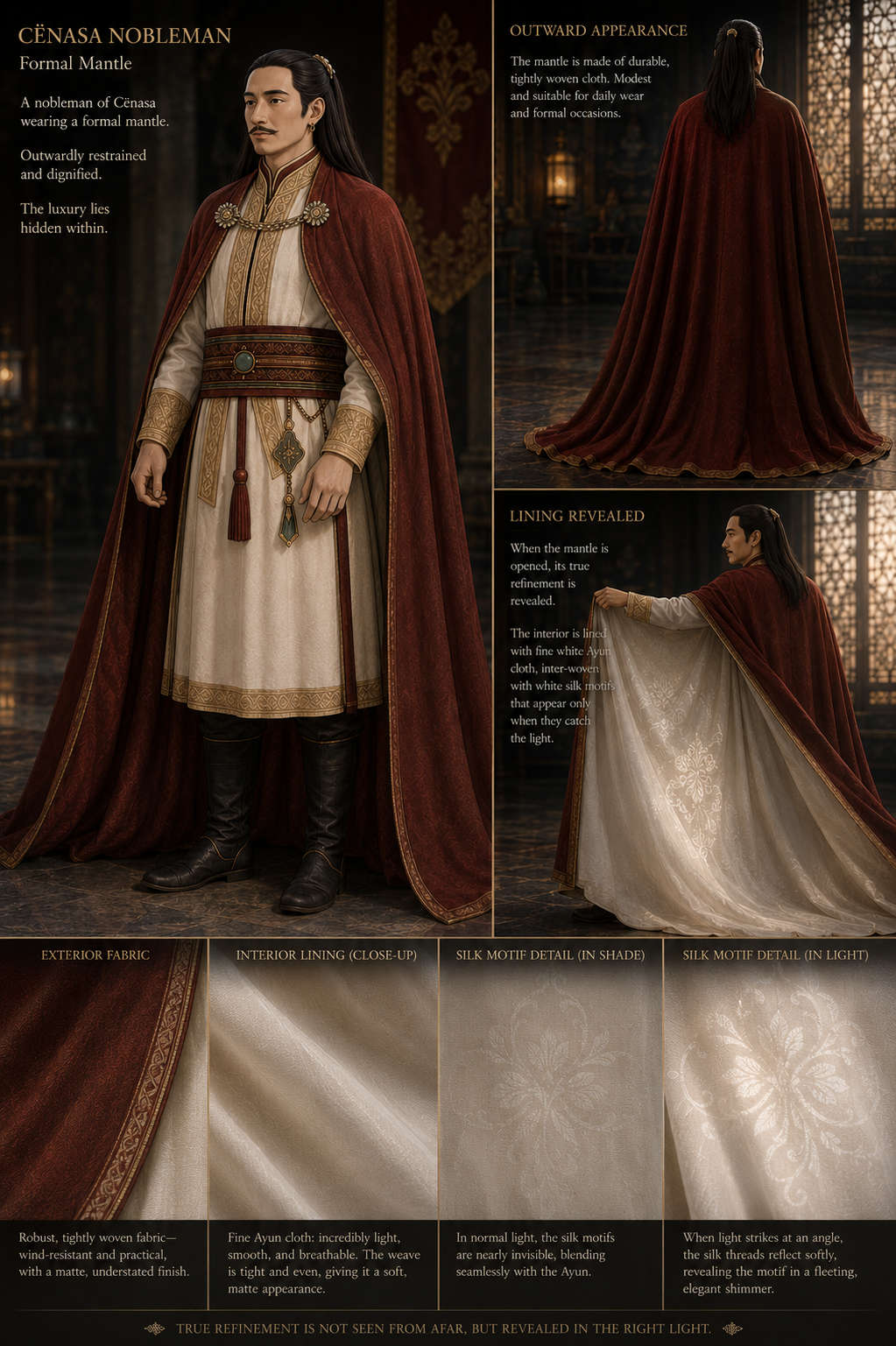
Clothing is also layered. An inner garment sits against the body; more durable or insulating materials are added outward by season and work. That modular habit suits Canassar's variable climate and later supported lined mantles and ceremonial outerwear whose luxury is often on the inside.
Traditional aesthetics favour a readable silhouette over dense surface ornament. Clothing tends to hang in clear vertical lines, with belts, collars, hems, and shoulder garments supplying structure. Men's historical dress emphasizes the torso and shoulders: tunics, trousers, broad belts, boots, and mantles or cloaks, often with long hair worn loose or only partly bound. Women's dress developed more volume below the waist through long skirts and layered lower garments, while keeping a fitted or controlled upper body and hair gathered into a bun, braid, or compact arrangement. The distinction is a tendency, not a rule. Many basic forms began as clothing worn by both sexes, and region and occupation can outweigh gender.
Decoration follows construction. Embroidery, woven borders, contrasting materials, and jewellery collect at cuffs, collars, front openings, belts, and hems, leaving large areas of relatively quiet cloth. Wealth can therefore be shown through weave, seam, fastening, or lining without changing the garment's overall shape.
Materials
The earliest known textiles were local bast fibres. Elm bark supplied ordinary cloth; deer hide, fur, and other animal products supplied outerwear, footwear, and protective pieces. Wool and heavier cloth became important in colder upland and northern communities. Leather remained common in footwear, belts, and working dress.
Ayun (literally "cloud") is the most prestigious indigenous textile, made from fisca bast grown chiefly in highland Maruen. It is valued for extremely low weight, breathability, a matte or diffuse surface, and resistance to creasing. Fine grades can be sheer, which limits their use on surfaces that take abrasion. Elite ayun was therefore well suited to protected inner layers, fine garments, and the linings of ceremonial outerwear. A high-status mantle may present a restrained exterior of heavier cloth while concealing a fine ayun lining patterned with silk; movement or a turn of light makes the silk motifs visible against the more diffuse ayun ground.
Silk entered through maritime exchange and became an important luxury without displacing ayun. Its lustre and fluid drape contrast with ayun's dry, airy, controlled character. Historical tailoring often combined the two rather than treating them as substitutes.
Jewellery and hair
Accessories belong to the architecture of the clothing. Belts secure garments and carry pouches, tools, tassels, and ornaments. Brooches and fasteners may hold a mantle and serve as jewellery at the same time.
Male jewellery has a long history. Earrings appear in reconstructions of early male dress and remained culturally acceptable later; materials range from bone and shell to precious metals and stones. Traditional representations generally show men clean-shaven or with a light, wispy moustache rather than a full beard, matching the sparse facial hair typical of Canassarene men.
Long hair was historically common among both sexes and could be tied, partly gathered, or arranged with pins and bands according to work, period, and region. More elaborate arrangements belong with formal and elite clothing. In later traditional dress, men's hair often remains visually massy around the head and shoulders, while women's hair is contained.
Status
Social standing was communicated as much through material quality and construction as through garment type. People at different levels could wear related silhouettes while differing in fibre, dye, lining, tailoring, embroidery, jewellery, and fastening materials. A garment need not be densely ornamented to be expensive. Fine ayun, precise borders, silk in an otherwise matte cloth, polished metal fittings, and careful hand construction could mark wealth to observers who knew the materials.
Region, occupation, and season could override status conventions. A wealthy Vërunar shipowner dressed for cold maritime weather might appear more heavily and practically clothed than a Cënasa aristocrat of comparable means.
Modern legacy
Industrialization and international fashion reduced everyday use of traditional regional clothing, though historical dress continues in ceremonial, religious, and festive settings, and in heritage workshops and garments derived from older styles. Modern designers more often reuse older principles than copy historical costumes: centre-front closures, decorative toggles, structured belts, contrasting linings, and the pairing of matte and lustrous textiles remain recognizable references.
Ayun still occupies an important place in luxury textile production. Manufacturing has widened its uses, but high-grade traditional ayun remains valued partly because its luxury is tactile rather than immediately conspicuous.
Visual continuity in Canassarene clothing lies less in any single garment than in a set of persistent design habits: constructed silhouettes, adaptable layering, centre-front fastening, ornament at structural edges, restrained exteriors, and attention to material quality. Those habits connect the bast-cloth and hide garments of prehistoric Canassar with later regional fashions and with the modern idea of Canassarene dress.