Prehistoric dress
Overview
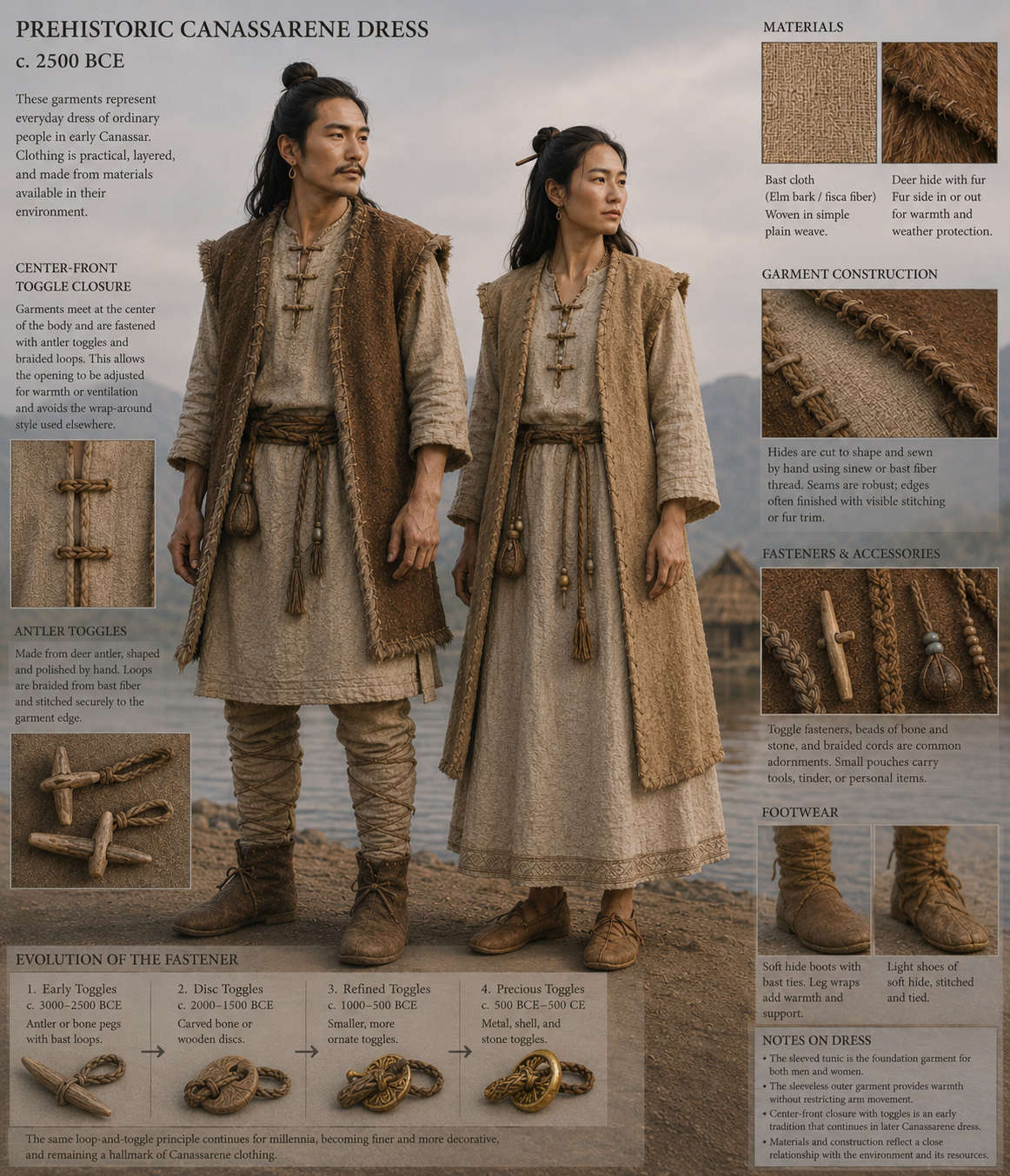
Prehistoric Canassarene dress is the clothing of communities on the island before the historically documented regional styles. Archaeological reconstruction places a formative stage in the late third and early second millennia BCE, when stitched bast-fibre garments, hide outerwear, fitted footwear, and toggle fastenings were already established.
Dress varied by climate, work, and access to materials, but several features that later defined Canassarene clothing were already present: constructed rather than wrapped garments, layered inner and outer materials, and centre-front fastening with toggles and loops. Historians of material culture therefore treat this period as the common ancestry of later Cënasa, Maruen, Vërunar, Armassin, and Hälvarinco dress.
Related articles: clothing; traditional clothing.
Materials
The ordinary textile was bast cloth from the inner bark of suitable trees, particularly elm. Bark fibres were retted, separated, softened, and spun or joined, then woven; simple plain weaves predominate in surviving impressions and reconstructions. Bast cloth was locally available, breathable, and more flexible than untreated hide, which made it suitable for tunics. Quality varied: carefully processed fibre could yield surprisingly fine cloth, while coarser stuff served work garments and sacks.
Animal products were equally important. Deer hide supplied sleeveless outer garments, footwear, belts, pouches, and protective pieces. Fur might be worn inward for insulation or outward against wind and wet weather. Sinew, bast fibre, and animal-derived cords were used for sewing. Bone and antler supplied needles, pins, toggles, and small ornaments.
Early processing of the fisca plant, from which later ayun cloth developed, may belong to this period. Such cloth would not yet have had the extreme fineness of historical ayun; early fisca textiles were probably one variety of high-quality bast cloth, refined over later centuries of specialized fibre work.
Garment construction
Garments were generally cut from several pieces and sewn into permanent three-dimensional forms, unlike systems based mainly on large rectangles wrapped or draped around the body. The basic garment for both sexes appears to have been a loose, sleeved tunic. Sleeves were broad enough for labour; the body fell freely from the shoulders and was normally secured at the waist with a cord or belt.
Over this was worn a sleeveless hide or heavy-cloth garment resembling a long vest. The absence of sleeves was practical: relatively stiff hides could protect the torso without restricting shoulders and elbows, so the piece could be worn while fishing, gathering, travelling, or working the land.
Visible seams were not necessarily hidden. Reinforced edges, whip stitching, and braided bindings formed part of the garment's appearance. Letting construction remain decorative persisted in later Canassarene tailoring.
Centre-front closure
The widespread centre-front toggle closure is one of the most consequential developments of this clothing. Early examples used short pieces of antler, bone, or hardwood passed through braided fibre loops on opposite edges. The two sides of a tunic or outer garment met along the body's centre line rather than overlapping extensively.
The arrangement was simple and useful. A garment could be opened fully, opened partly for ventilation, or closed closely in cold weather without wrapping one side across the other. Later tailors refined the same mechanical principle: antler pegs gave way to shaped bone and wooden toggles, then to smaller ornamental fasteners of metal, shell, stone, and other valued materials. By the historical period, a practical solution had become a visible element of Canassarene dress.
Men's and women's dress
Men generally wore a sleeved tunic to about the knee, secured with a braided cord or narrow belt. Loose trousers or separate leg coverings were worn beneath it, especially in colder regions. Lower legs could be wrapped with strips of cloth or hide. The sleeveless outer vest was prominent in working dress: heavy fur-bearing hide for warmth, lighter examples to protect the cloth beneath from abrasion.
Men commonly wore small earrings, probably first of bone, shell, polished stone, or simple metal rings. Archaeologists generally treat male earrings as one of the earliest persistent personal ornaments in Canassar; later elite forms appear to develop from this older practice. Hair was commonly long, gathered partly or fully during physical work. Facial hair was sparse; reconstructions conventionally show a light or wispy moustache and little or no beard.
Women's clothing used the same constructional vocabulary rather than a separate dress system: sleeved, centre-fastened bast tunics, with sleeveless hide or heavy-cloth outer garments added for weather. Women's lower garments were generally longer and increasingly voluminous. That modest difference is treated as the beginning of a later visual split, in which male dress concentrates mass around the shoulders and upper torso, and women's dress emphasizes the lower body. At this date the distinction was mainly practical; the elaborate gendered silhouettes of historical fashion had not yet formed. Hair could be worn loose, partly bound, or in simple knots. Elaborate pinned arrangements belong to later metalworking and hair ornaments.
Footwear, belts, and ornament
Footwear consisted mainly of soft hide shoes and boots cut to the foot and sewn with sinew or fibre. Additional hide layers could thicken the sole. Higher footwear was useful in cold or mountainous country. Cloth or hide wrapping around the calves added insulation and kept debris and moisture out of the shoe. The heavy structured boots of later dress developed gradually from these flexible forms.
Belts were practical. In the absence of sewn pockets, small tools and possessions hung from waist cords or sat in hide pouches. Decorative beads, tassels, and small objects could be attached to the same belts. Bone, shell, antler, stone, and braided fibre supplied most personal ornament. Decoration concentrated on edges, fasteners, and attachments—neck openings, seams, belts, cuffs, and toggles—rather than covering the whole garment. That habit remained durable: later elite clothing still tends to work collars, hems, closures, and belts rather than treating the cloth as an uninterrupted decorative field.
Status and season
Differences in dress probably reflected wealth, occupation, and position, though less sharply than in later hierarchical society. Status was shown mainly through quality rather than through wholly different garment types. A prosperous person might have finer bast cloth, softer and more evenly worked hides, carefully carved toggles, imported shells, or polished ornaments, while poorer people wore clothing built on the same principles. Later fashion kept that pattern: hierarchy often speaks through material and workmanship rather than through exclusive categories of clothing.
Layering was the response to a temperate and often wet climate. A light bast tunic could serve in warm weather; hide vests, fur-lined outer pieces, leg wrappings, and heavier footwear were added as conditions worsened. The system was modular: combinations of layers changed with temperature, wind, rain, and activity, rather than a single heavy winter garment. That emphasis on adaptable layers survived into historical dress and later into mantles, lined outerwear, and contrasting inner and outer textiles.
Later development
Clothing of about 2500 BCE would have looked markedly simpler than later regional costume, but several foundations were already in place. The sleeveless hide vest is a structural ancestor of later mantles and shoulder garments. The belted tunic established the basic vertical silhouette of men's clothing. Longer women's garments anticipated fuller lower silhouettes. The toggle-and-loop fastening encouraged tailoring around symmetrical centre-front construction.
Improved weaving, metalworking, and interregional trade then transformed practical features into more sophisticated forms. Toggles became jewellery; braided borders became woven trims; protective outer layers became formal mantles; finer bast textiles contributed to ayun; and climate and economy increasingly differentiated local dress. The result was refinement of the prehistoric system rather than its replacement. Prehistoric dress is therefore treated as the foundational phase of the Canassarene sartorial tradition: an austere clothing system whose solutions to fastening, layering, tailoring, and climate remained visible thousands of years later.